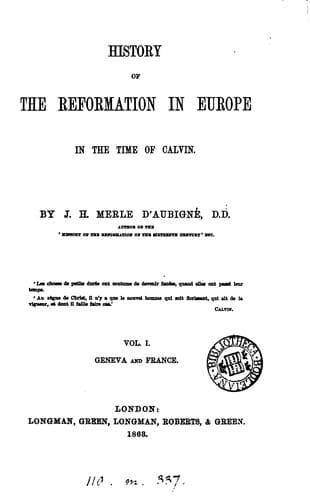
History of the Reformation in Europe in the Time of Calvin, Vol. 6 (of 8)Merle d'Aubigné, J. H. (Jean Henri)
History
History of the Reformation in Europe in the Time of Calvin, Vol. 6 (of 8)
Merle d'Aubigné, J. H. (Jean Henri)
Reformation
Before the days of the Reformation, Scotland received three great
impulses in succession from the Christian countries of the south.
The persecutions which at the close of the second century, during
the course of the third, and at the beginning of the fourth, fell on
the disciples of the Gospel who dwelt in the southern part of Great
Britain, drove a great number of them to take refuge in the country of
the Scots. These pious men built for themselves humble and solitary
hermitages, in green meadows or on steep mountains, and in narrow
valleys of the glens; and there, devoting themselves to the service of
God, they shed a soft gleam of light in the midst of the fogs of every
kind which encompassed them, teaching the ignorant and strengthening
the weak. They were called in the Gaelic tongue _gille De_, servants of
God, in Latin _cultores Dei_; and in these phrases we find the origin
of the name by which they are still known--_Culdees_. Such was the
respect which they inspired that, after their death, their cells were
often transformed into churches.[1] From them came the first impulse.
[Sidenote: THE CULDEES.]
Several centuries passed away; the feudal system was established in
Scotland. The mountainous nature of the country, which made of every
domain a sort of fortress, the fewness of the large towns, the absence
of any influential body of citizens, the institution of clans, the
limited number of the nobles,--all these circumstances combined to
make the power of the feudal lords greater than in any other European
country; and this power at a later period protected the Reformation
from the despotism of the kings. But the influence of the Culdees,
though really perceptible in the Middle Ages, was very feeble. It may
be said of the things of grace in Scotland as of the works of Creation,
that the sun did not come to scatter the mists which brooded over a
nature melancholy and monotonous, and that the influence of the winds
which, rushing forth from the neighboring seas, roared and raged over
the barren heaths or over the fertile plains of Caledonia, was not
softened by the breath divine which comes from heaven.
But in the days of the revival a sweet and subtile sound was heard,
and the surface of the lochs seemed to become animated. Wickliffe,
having given to England the Word of God, some of his followers, and
particularly John Resby, came into Scotland. ‘The pope is nothing,’
said Resby in 1407,[2] and he taught at the same time that Christ is
everything. He was burnt at Perth.... Thus it was from the disciples of
Wickliffe, the _Lollards_, that the second impulse came.
Public-domain text, read in full here on John Shaqi.
Reviews
Reviews
No reviews yet
Be the first to share your thoughts on this work.
Join the Discussion
Join the discussion
Sign in to leave a comment or review.
Sign InorCreate an account