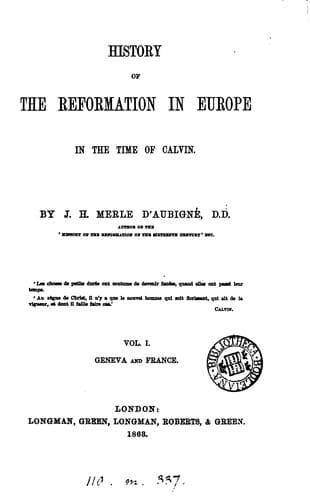
History of the Reformation in Europe in the Time of Calvin, Vol. 6 (of 8)Merle d'Aubigné, J. H. (Jean Henri)
History
History of the Reformation in Europe in the Time of Calvin, Vol. 6 (of 8)
Merle d'Aubigné, J. H. (Jean Henri)
Reformation
The _reveillé_ of Wickliffe was echoed in Eastern Europe by that of
John Huss. In 1421, a Bohemian, one Paul Crawar, arriving from Prague,
expounded at St. Andrews the Word of God, which he cited with a
readiness and accuracy that astonished his hearers.[3] When led away to
execution and bound to the stake, the bold Bohemian said to the priests
who stood round him, ‘Generation of Satan, you, like your fathers, are
enemies of the truth.’ The priests, not relishing such speeches in the
presence of the crowd, had a ball of brass put into his mouth,[4] and
the martyr thus silenced was burnt alive without any further protest on
his part.
However, Patrick Graham, archbishop of St. Andrews and primate of
Scotland, nephew of James I., and a man distinguished for his
abilities and his virtues, had heard Crawar. If the heart of the priest
had been hard as a stone the heart of the archbishop was like a fertile
field. The Word of the Lord took deep root in him. He formed the
project of reformation of the Church; but the clergy were indignant;
the primate was deprived, was condemned to imprisonment for life, and
died in prison.
Then began that struggle between royalty and the nobility which was
afterwards to become one of the characteristic features of the time of
reform. Kings, instigated by ambitious priests, sought to humble the
nobles; the latter were thus predisposed to promote the Reformation.
James II. (1437-1460) fought against the nobles both with the sword
and by severe laws. James III. (1460-1488) removed them with contempt
from his Court and gave himself up to unworthy favorites. James IV.
(1488-1503), a man of a nobler spirit, esteemed the aristocracy the
ornament of his Court and the strength of his kingdom. During the reign
of this prince appeared the first glimmerings of the Reformation.
Some pious men, dwellers most of them in the districts of Hill and
Cunningham, were enlightened by the Gospel, and, confronting the Roman
papacy, boldly declared that all true Christians receive every day
spiritually the body of Jesus Christ by faith; that the bread remains
bread after consecration, and that the natural body of Christ is not
present; that there is a universal priesthood, of which every man and
woman who believes in the Saviour is a member; that the pope, who
exalts himself above God, is against God; that it is not permissible to
take up arms for the things of faith; and that priests may marry.
[Sidenote: JOHN CAMPBELL, LAIRD OF CESSNOCK.]
Public-domain text, read in full here on John Shaqi.
Reviews
Reviews
No reviews yet
Be the first to share your thoughts on this work.
Join the Discussion
Join the discussion
Sign in to leave a comment or review.
Sign InorCreate an account