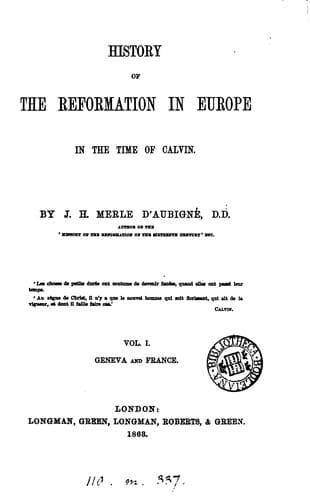
History of the Reformation in Europe in the Time of Calvin, Vol. 6 (of 8)Merle d'Aubigné, J. H. (Jean Henri)
History
History of the Reformation in Europe in the Time of Calvin, Vol. 6 (of 8)
Merle d'Aubigné, J. H. (Jean Henri)
Reformation
About a year after the combat in which Sir Patrick was killed, the duke
of Albany returned, with the intention of bringing about an intimate
alliance between Scotland and France. Margaret Tudor, who wished for an
alliance with England, and who found herself deprived of power by the
arrival of Albany, wrote on September 13, 1523, to her brother Henry
VIII.: ‘The person and the kingdom of my son are exposed to very great
danger; come to our aid, come in all haste, or it is all over with my
son!’[23] It might perhaps have been all over with the Reformation
too--a far more important matter. But Albany, although he was at the
head of a fine army, fled on two occasions before the English, and
being despised by everybody, quitted Scotland forever at the close of
May 1524.[24]
[Sidenote: WRITINGS OF LUTHER PROSCRIBED.]
He had only just set sail when the cause of the Reformation, threatened
by his presence, received a powerful reinforcement. In 1524, and at
the beginning of 1525, some books of Luther and of other Reformers
were brought into Scotland by merchant-ships, and getting dispersed
over the country, produced there the same effect as they had in France
and in Italy. Gawin Dunbar, the old bishop of Aberdeen, was the first
to become aware of this. He discovered one day a volume of Luther
in his own town. He was in consternation when he saw that the fiery
darts hurled by the hand of the heretic were crossing the sea. As like
discoveries were made in Linlithgow, St. Andrews, and other places, the
affair was brought before Parliament. ‘Damnable heresies are spread
abroad in various countries,’ said the partisans of Rome. ‘This kingdom
of Scotland, its sovereigns and their subjects, have always stood fast
in the holy faith since they received it in the primitive age; attempts
are being made at this moment to turn them away from it. Let us take
all needful steps to repulse the attack.’ Consequently, on July 17,
1525, parliament enacted that no person arriving in any part of the
kingdom should introduce any book of Luther or of his disciples, or
should publish the opinions of that German except for the purpose of
refuting them, ‘Scotland having always bene clene of all filth and
vice.’[25]
This act was immediately published throughout the country, and
particularly at all ports, in order that no one might be able to
pretend ignorance of it. About four days after the closing of
parliament the sheriffs received orders from the king’s council to
set on foot without delay the necessary inquiries for the discovery
of persons who might possess any books of Luther, or who should
profess his errors. ‘You will confiscate their books,’ the order ran,
‘and transmit them to us.’ The Reformation, which till that time had
been almost unknown in those regions, became suddenly a public fact,
proclaimed by the highest body in the realm, and was on the point of
preoccupying all minds. The enemies of the truth were preparing its
triumph.
Public-domain text, read in full here on John Shaqi.
Reviews
Reviews
No reviews yet
Be the first to share your thoughts on this work.
Join the Discussion
Join the discussion
Sign in to leave a comment or review.
Sign InorCreate an account