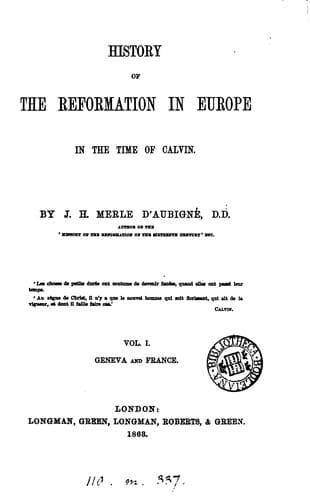
History of the Reformation in Europe in the Time of Calvin, Vol. 6 (of 8) — John Shaqi
History of the Reformation in Europe in the Time of Calvin, Vol. 6 (of 8)Merle d'Aubigné, J. H. (Jean Henri)
History
History of the Reformation in Europe in the Time of Calvin, Vol. 6 (of 8)
Merle d'Aubigné, J. H. (Jean Henri)
Reformation
On the appointed day Hamilton entered the great hall of the university,
in which were gathered professors, students, and a numerous audience
besides. He announced that he was about to establish a certain number
of truths respecting _the law and the Gospel_, and that he would
maintain them against all comers. These theses, all of a practical
character, had however somewhat of that dialectical spirit which
distinguished at a subsequent period the philosophical schools of
Scotland, and were drawn up in a pure and _lapidary_ style which
secures for this theologian of three-and-twenty a noteworthy place
among the doctors of the sixteenth century.
[Sidenote: HAMILTON’S THESES.]
‘There is a difference, and even an opposition, between the law and
the Gospel,’ said Hamilton. ‘The law showeth us our sin; the Gospel
showeth us remedy for it. The law showeth us our condemnation; the
Gospel showeth us our redemption. The law is the word of ire; the
Gospel is the word of grace. The law is the word of despair; the Gospel
is the word of comfort. The law is the word of unrest; the Gospel is
the word of peace.[54] The law saith, Pay thy debt; the Gospel saith,
Christ hath paid it. The law saith, Thou art a sinner--despair, and
thou shalt be damned; the Gospel saith, Thy sins are forgiven thee:
be of good comfort, thou shalt be saved. The law saith, Make amends
for thy sins; the Gospel saith, Christ hath made it for thee. The law
saith, The Father of heaven is angry with thee; the Gospel saith,
Christ hath pacified him with his blood. The law saith, Where is thy
righteousness, goodness, and satisfaction? the Gospel saith, Christ
is thy righteousness, thy goodness, thy satisfaction. The law saith,
Thou art bound and obliged to me, to the devil and to hell; the Gospel
saith, Christ hath delivered thee from them all.’[55]
The attack began, and the defence of the young Master of Arts was as
remarkable as his exposition. Even though he made use of the syllogism,
he shook off the dust of the school, and put something perspicuous
and striking in its place. When one opponent maintained that a man is
justified by the law, Hamilton replied by this syllogism:--
‘That which is the cause of condemnation cannot be the cause of
justification.
‘The law is the cause of condemnation.
‘Therefore the law is not the cause of justification.’
His phraseology, clear, concise, and salient--rare qualities in
Germany, except perhaps in Luther--his practical, transparent,
conscientious Christianity--struck the minds of his hearers. Certainly,
said Lambert, Hamilton has put forward thoroughly Christian axioms, and
has maintained them with a great deal of learning.[56]
Public-domain text, read in full here on John Shaqi.
Reviews
Reviews
No reviews yet
Be the first to share your thoughts on this work.
Join the Discussion
Join the discussion
Sign in to leave a comment or review.
Sign InorCreate an account