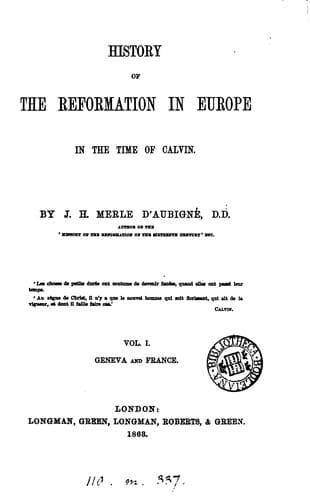
History of the Reformation in Europe in the Time of Calvin, Vol. 6 (of 8)Merle d'Aubigné, J. H. (Jean Henri)
History
History of the Reformation in Europe in the Time of Calvin, Vol. 6 (of 8)
Merle d'Aubigné, J. H. (Jean Henri)
Reformation
Hamilton engaged in other public disputations besides this. As faith in
Christ and justification by faith is the principle which distinguishes
Protestantism from other Christian systems, he felt bound to establish
the nature, importance, and influence of that doctrine. He believed
that faith is born in a man’s heart when, as he hears or reads the
Word of God, the Holy Spirit bears witness in his heart to the main
truth which is found in it, and shows him with clear proof that Jesus
is really an almighty Saviour. Faith was for the young Scotchman a
divine work, which he carefully distinguished from a faith merely
human. On this subject he laid down and defended the following
propositions:--‘He who does not believe the Word of God, does not
believe God himself. Faith is the root of all that is good; unbelief is
the root of all evil. Faith makes friends of God and of man; unbelief
makes enemies of them. Faith lets us see in God a father full of
gentleness; unbelief presents him to us as a terrible judge. Faith sets
a man steadfast on a rock; unbelief leaves him constantly wavering and
tottering. To wish to be saved by works is to make a man’s self his
saviour, instead of Jesus Christ. Wouldst thou make thyself equal with
God? Wouldst thou refuse to accept the least thing from him without
paying him the value of it?’
Fryth, who doubtless took part in the discussion, was so much struck
with these theses that he translated them into English, and by that
means they have come down to us. ‘The truths which Hamilton expounded
are such,’ said he, ‘that the man who is acquainted with them has the
_pith_ of all divinity.’[57] ‘This little treatise is short,’ said
others who listened to him, ‘but in effect it comprehendeth matter able
to fill large volumes.’[58] Yes, Christ is the author of redemption, and
faith is the eye which sees and receives him. There are only these two
things: Christ sacrificed and the eye which contemplates him. The eye,
it is true, is not man’s only organ; we have besides hands to work,
feet to walk, ears to hear, and other members more for our service. But
none of all these members can see, but only the eye.[59]
[Sidenote: HAMILTON’S THESES.]
Public-domain text, read in full here on John Shaqi.
Reviews
Reviews
No reviews yet
Be the first to share your thoughts on this work.
Join the Discussion
Join the discussion
Sign in to leave a comment or review.
Sign InorCreate an account