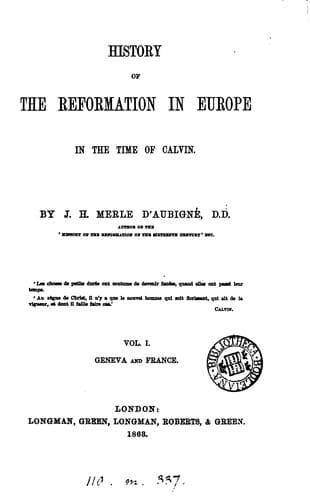
History of the Reformation in Europe in the Time of Calvin, Vol. 8 (of 8)Merle d'Aubigné, J. H. (Jean Henri)
History
History of the Reformation in Europe in the Time of Calvin, Vol. 8 (of 8)
Merle d'Aubigné, J. H. (Jean Henri)
Reformation
One day a young girl, named Sancha de Carile, daughter of a señor
of Cordova, was preparing to go to court, where she had just been
appointed maid of honor to the queen. She wished first to have a
conversation with John d'Avila, and was so touched by his words that
she thenceforth abandoned the court and the world. Instead, however,
of entering a convent, she remained in her father's house, and there
devoted herself till death to the service of Jesus Christ, whom she
had found as her Saviour.[21] It was for Sancha de Carile that D'Avila
composed his principal work, entitled _Audi, filia, et vide_ ('Hearken,
O daughter, and consider'[22]), Ps. xlv. 10. D'Avila did not side with
the doctors and disciples of the Reformation, who were continually
increasing in number in Germany. He differed from them, indeed, on
several points, but on others approached them so nearly that his
preaching could not but prepare men's minds to receive the fulness of
evangelical doctrine. The Inquisition understood this.[23]
[Sidenote: AN EXAMINATION.]
The period which elapsed between 1520 and 1535 was an epoch which
prepared the way for reformation in Spain. In the universities, in the
towns, and in country places many minds were silently inclining towards
a better doctrine. The Reformation was then like fire smouldering under
the ashes, but was to manifest itself later in many a noble heart.
Nevertheless, from time to time the flame became visible. A peasant, a
simple man without any culture whatever, who had busied himself only
about his fields, had by some means received Christian convictions.[24]
One day, when in company with some relations and friends, he exclaimed,
'It is Christ who, with his own blood, daily washes and purifies from
their sins those who belong to him, and there is no other purgatory.'
It seems that the poor man had only repeated a saying which he had
heard in some meeting, and which had pleased him, without being
penetrated by the truth which he had expressed. When, therefore,
he was cited before the inquisitors of the faith, he said, 'I have
certainly held that opinion, but, since it displeases your reverences,
I willingly retract it.' This did not satisfy the priests. They heaped
reproaches upon him. 'They may have feared,' says the author of the
_Artifices of the Spanish Inquisition_, 'that their inquisitive
faculties would stagnate and rot unless they set about finding some
knavery in the man, thus pretending to find knots in a bulrush--_nodus
in scirpo_.' 'You have asserted that there is no purgatory. _Ergo_ you
believe that the pope is mistaken--that the councils are mistaken--and
that man is justified by faith alone.' In short, they unfolded before
him all the doctrines which they called heresies, and charged the
unfortunate man with them as if he had actually professed them. The
poor peasant protested; he confidently maintained that he did not even
know what these doctrines meant. But they insisted on their charge,
Public-domain text, read in full here on John Shaqi.
Reviews
Reviews
No reviews yet
Be the first to share your thoughts on this work.
Join the Discussion
Join the discussion
Sign in to leave a comment or review.
Sign InorCreate an account