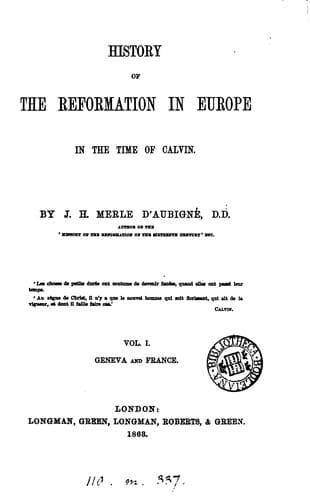
History of the Reformation in Europe in the Time of Calvin, Vol. 8 (of 8)Merle d'Aubigné, J. H. (Jean Henri)
History
History of the Reformation in Europe in the Time of Calvin, Vol. 8 (of 8)
Merle d'Aubigné, J. H. (Jean Henri)
Reformation
and showed him the close connection which subsists between all these
dogmas. The poor man had been deprived of the ordinary means of
instruction; but these priests, who were more opposed to the Gospel
than water is to fire, says the narrator, taught and enlightened him.
Those who boasted themselves to be the great extirpators of the truth
became its propagators. The peasant of whom we speak thus attained
to the fulness of the faith which hitherto had only just dawned upon
him. It was a striking example of the wonderful way in which Divine
Goodness sometimes calls its chosen ones. There were many other such
instances.'[25]
[Sidenote: RODRIGO DE VALERIO.]
The chief reformer of Spain was to spring from a higher class. He
was born in Andalusia, the Baetica which in the eyes of the ancients
was the fairest and happiest of all the countries in the world. Near
rocky mountains, on a vast plain of picturesque and solemn aspect,
lies Lebrixa, an ancient town about ten leagues from Seville on the
Cadiz side. Here lived Rodrigo de Valerio, a young man of a rich and
distinguished family. He had, in common with the Andalusians, great
quickness of apprehension; fancy sparkled in his speech, and his
temperament was very cheerful. Like them, he was distinguished by his
love of pleasure, and it was his glory to surpass in its indulgence all
the young men with whom he associated. He generally lived at Seville, a
town called by the Romans 'little Rome' (_Romula_), which had long been
a centre of intelligence, and where the Alcazar and other monuments
recalled the magnificence of the Moorish kings. Rodrigo had received a
liberal education, and had learned a little Latin; but this had been
speedily forgotten amidst the diversions of youth. There was not a hunt
nor a game at which he was not present. He was to be seen arriving at
the rendezvous mounted on a superb horse, richly equipped, and himself
magnificently attired.[26] Easy and skilful in bodily exercises, he
carried away every prize. Full of grace and elegance, he succeeded in
winning the favor of fair ladies. His delight was to mount the wildest
horse, to scale the rocks, to dance with light foot, to hunt with horn
and hound, to draw the cross-bow or shoot with the arquebus, and to
be the leader of fashionable young men in every party and at every
festival.
Public-domain text, read in full here on John Shaqi.
Reviews
Reviews
No reviews yet
Be the first to share your thoughts on this work.
Join the Discussion
Join the discussion
Sign in to leave a comment or review.
Sign InorCreate an account