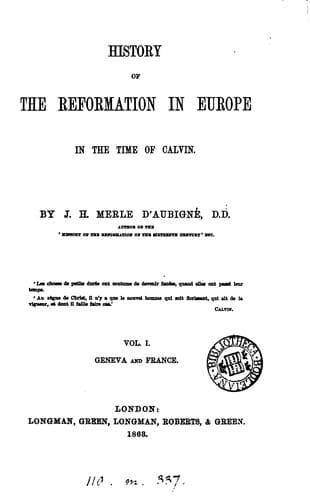
History of the Reformation in Europe in the Time of Calvin, Vol. 8 (of 8)Merle d'Aubigné, J. H. (Jean Henri)
History
History of the Reformation in Europe in the Time of Calvin, Vol. 8 (of 8)
Merle d'Aubigné, J. H. (Jean Henri)
Reformation
All at once Valerio disappeared from society. He was sought at the
games, in the dance, at the races, but was nowhere to be found. Every
one was asking what had become of him. He had abandoned every thing.
The pleasures of the world had oppressed and wearied him, and he had
found all void and bitterness. What! thought he, play the lute, make
one's horse caper, sing, dance ... and forget what it is to be a man!
A voice had cried in his heart that God was all in all. He had yielded
to no human influence; God alone had touched him by his Spirit.[27]
The change was for this reason all the more remarkable. The lively
affections of his heart, which had hitherto rushed like a tempestuous
torrent downwards towards the world, now rose with the same energy
towards heaven. 'A divine passion,' says a contemporary, 'suddenly
seized him.[28] Casting off his old inclinations, and despising human
judgment, he applied his whole strength, both of mind and body, so
zealously to the pursuit of piety, that no worldly affection seemed to
be left in him.' If Rodrigo had then retired to a convent, all would
have been _en règle_, and every one would have admired him; but no one
could understand why, while renouncing pleasure, he did not immediately
shut himself up in one of those human sanctuaries to which alone the
world at that time gave the patent of a devout life. Some, indeed,
of the remarks made on him were very natural. He had passed from one
extreme to the other, and in his first fervor he exposed himself to
the ridicule of his old companions. The young man who had hitherto
been remarkable for the delicacy of his manners, the elegance of his
discourse, and the splendor of his dress, displayed now a somewhat
repulsive roughness and negligence.[29] Sincere and upright, but as
yet unenlightened, unacquainted indeed with any other pious life than
that of ascetics, it is not astonishing that he threw himself at first
into an exaggerated asceticism. He thought that he should thus renounce
the world more completely and make a more perfect sacrifice to the
Lord. He has lost his head, said some; he is drunk, said others. But
on closer observation the true fear of God was to be seen in him,
a sincere repentance for the vanity of his life, an ardent thirst
for righteousness, and an indefatigable zeal in acquiring all the
characteristics of true piety. But one thing above all occupied his
mind. We have seen that he had learned Latin. This knowledge, which he
had despised, now became of the greatest service to him. It was only in
this language that the sacred writings could be read; he studied them
day and night;[30] by means of hard toil he fixed them in his memory,
and he had an admirable gift for applying the words of Scripture with
correctness and promptitude. He endeavored to regulate his whole
conduct by their teaching; and people perceived in him the presence of
the Spirit by whom they were dictated.
Public-domain text, read in full here on John Shaqi.
Reviews
Reviews
No reviews yet
Be the first to share your thoughts on this work.
Join the Discussion
Join the discussion
Sign in to leave a comment or review.
Sign InorCreate an account