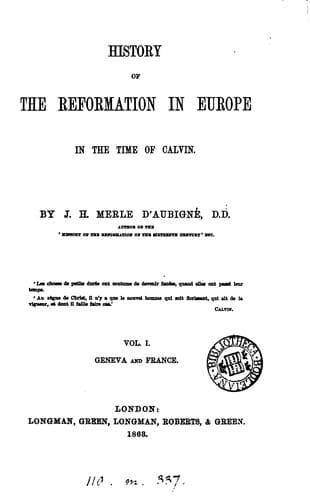
History of the Reformation in Europe in the Time of Calvin, Vol. 8 (of 8)Merle d'Aubigné, J. H. (Jean Henri)
History
History of the Reformation in Europe in the Time of Calvin, Vol. 8 (of 8)
Merle d'Aubigné, J. H. (Jean Henri)
Reformation
Valerio became one of the apostles of the doctrines of Luther and the
other reformers.[31] 'It was not in their own writings that he had
learned these. He had derived them directly from the Holy Scriptures.
Those sacred books, which, according to some, are the source of such
various doctrines, then produced in every country of Christendom the
same faith and the same life.' He soon began to diffuse around him the
light he had received. People were astonished at hearing this young
layman, who had recently made one of every party of pleasure, speaking
with so much fervor. 'From whom do you hold your commission?' asked
some one. 'From God himself,' replied he, 'who enlightens us with his
Holy Spirit, and does not consider whether his messenger is a priest or
a monk.'
[Sidenote: JOHN DE VERGARA.]
Valerio was not the only one to awaken from sleep. A literary movement
in the path opened by Erasmus had, as we have already said, prepared
the way of the Gospel in Spain. One of its chiefs was John de Vergara,
canon of Toledo, who had been secretary to Cardinal Ximenes. An
accomplished Greek and Hebrew scholar, he had pointed out some errors
in the Vulgate; and he was one of the editors of the Polyglot of
Alcala. 'With what pleasure do I learn,' wrote the scholar of Rotterdam
to him in 1527, 'that the study of languages and of literature is
flourishing in that Spain which was of old the fruitful mother of
the greatest geniuses.' John de Vergara had a brother named Francis,
a professor of Greek literature at Complutum (the present Alcala de
Henares). Alcala, near Madrid, the seat of the foremost university
in the kingdom next to Salamanca, was at this epoch a centre of
intelligence, and had acquired a European renown. A breath of freedom
and life seemed to have passed over it. John and Francis, with another
Spaniard, Bernardin de Tobar, apparently their brother, put forth
their united efforts to revive the pursuit of literature in their
native land, and kindled bright hopes in the breast of the prince of
the schools. Calling to mind, as was his wont, the stories of ancient
times, Erasmus compared these three friends of letters to Geryon,
king of the Balearic Islands, the most powerful of men, of whom the
poets had made a giant with three bodies. 'Spain,' said he, 'has once
more its Geryon, with three bodies but one spirit, and the happiest
anticipations are excited in our minds.'[32] The modern Geryon,
however, failed to win the honor of the triumph promised by Erasmus. In
the Inquisition he met the Hercules who vanquished him. These eminent
men had found their way through the love of learning to the love of
the Gospel; and John had carried his audacity to such a pitch that
he aimed at correcting the Vulgate. Hereupon certain monks who knew
nothing of Latin beyond the jargon of the schools raised the alarm.
John and Tobar were arrested by the inquisitors of Toledo, cast into
a dungeon, and called upon to renounce the _heresies_ of Luther. This
Public-domain text, read in full here on John Shaqi.
Reviews
Reviews
No reviews yet
Be the first to share your thoughts on this work.
Join the Discussion
Join the discussion
Sign in to leave a comment or review.
Sign InorCreate an account