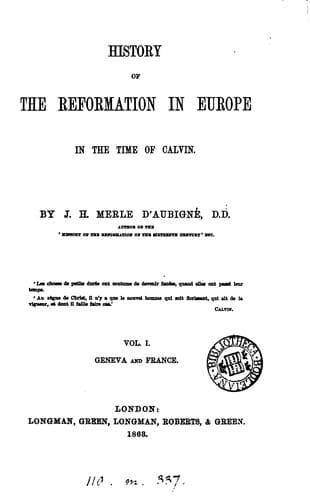
History of the Reformation in Europe in the Time of Calvin, Vol. 8 (of 8)Merle d'Aubigné, J. H. (Jean Henri)
History
History of the Reformation in Europe in the Time of Calvin, Vol. 8 (of 8)
Merle d'Aubigné, J. H. (Jean Henri)
Reformation
charge they had not at all anticipated. It was not by the reformer,
but by his opponent, Erasmus, that they had been attracted to the Holy
Scriptures. Being as yet weak in faith, they thought they might declare
themselves unacquainted with Lutheranism; and they were released.
Certain penances, however, were imposed on them, and they were placed
under the _surveillance_ of the Inquisition?[33]
At this time, between 1530 and 1540, a great theological controversy
was being carried on in the university of Alcala. One of the champions
was Matthew Pascual, a doctor distinguished for his acquirements in
learning--he was master of Hebrew, Greek, and Latin--for his love
of letters, of the Holy Scriptures, and of a doctrine more pure
than that of the monks. The discussion had become animated; and the
opponent of Pascual, in the heat of the conflict, exclaimed--'If the
case be as Doctor Matthew maintains, it would follow that there would
be no purgatory!' Pascual had probably said with St. John that _the
blood of Jesus Christ his Son cleanseth us from all sin_. He replied
simply--'What then? (_Quid tum?_)' The monks were all agitated
at these words. 'He said _Quid tum!_ He denies purgatory.' He was
forthwith committed to the prison of the holy fathers,[34] from which
he was not liberated till long afterwards, and then with the loss of
all his property. He then left Spain. Two monosyllables had cost him
dear.
[Sidenote: PETER DE LERMA.]
There was resident at Alcala at this time a man who far surpassed
the Vergaras and the Pascuals, and whose judgments were universally
accepted in Spain as oracles.[35] This was Peter de Lerma, abbot of
Alcala, canon, professor of theology, and chancellor of the university,
skilled in the oriental languages, which he had studied in Paris, and
well versed in Scholastic theology. He was highly esteemed throughout
the whole Peninsula. He was consulted on the greatest affairs of
state; and many had recourse to him as to a touch-stone which at once
indicated to them what was good and what was evil. As he was wealthy
and belonged to a noble family of Burgos, he had great influence. From
an early age he gave himself up to the reading of the Holy Scriptures,
convinced that without them it was impossible to attain any real
knowledge of holy things. At an advanced age he read the works of
Erasmus. His mind was enlightened by them; and he acknowledged that
the studies pursued at the universities served only for vain display.
A new form was given to his activity, and his words were henceforth
remarkable for their freedom, their simplicity, and their vigor.
'Draw,' said he, 'from the oldest sources; do not take up opinions upon
the sole authority of any masters, however solid they may be.' Words
like these were altogether new in the Catholic churches. Peter de Lerma
was a kindly old man, now aged about seventy. The monks, regardless of
his age, his attainments, or the authority which he enjoyed, had him
Public-domain text, read in full here on John Shaqi.
Reviews
Reviews
No reviews yet
Be the first to share your thoughts on this work.
Join the Discussion
Join the discussion
Sign in to leave a comment or review.
Sign InorCreate an account