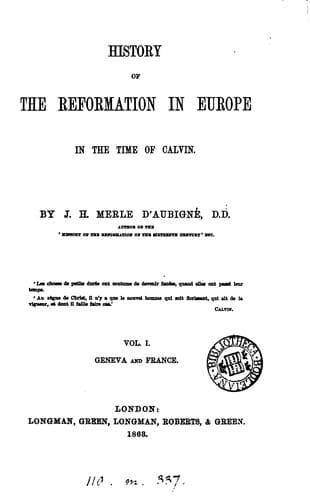
History of the Reformation in Europe in the Time of Calvin, Vol. 8 (of 8) — John Shaqi
History of the Reformation in Europe in the Time of Calvin, Vol. 8 (of 8)Merle d'Aubigné, J. H. (Jean Henri)
History
History of the Reformation in Europe in the Time of Calvin, Vol. 8 (of 8)
Merle d'Aubigné, J. H. (Jean Henri)
Reformation
cast into prison by their agents. His opponents attacked him in private
conferences. But the aged doctor, finding that the best reasons were of
no avail with his enemies, that they refused to listen to the truth,
and had no regard for innocence, declared that he would hold no more
discussion with Spaniards, and required them to summon learned men of
other lands, capable of understanding the evidence laid before them. To
the inquisitors this seemed to be horrible blasphemy. 'Would it not be
said,' they exclaimed, 'that the holy fathers of the Inquisition may
be in error, and that they are unable to comprehend a hundred others
better than you?' They assailed him with insults, they plagued him
in the prison, they threatened him with torture. The poor old man at
last, enfeebled by age and by persecution, and not yet sufficiently
established in the faith, as was usually the case with the converts of
Erasmus, complied with the demands of his persecutors. He then withdrew
to Burgos, his native place. Melancholy weighed him down. The energies
of his soul were crushed. His hopes for the future of his people had
vanished. He bowed down his head and suffered. Informed ere long that
it was intended to arrest him, he fled to Flanders; then went to Paris,
where he died dean of the Sorbonne, and professor of theology in that
university.
The preaching of the old man was not fruitless in Spain. Like John
d'Avila and others, he was one of those Spanish evangelicals who did
not make use of Luther's name, but asserted that they preached simply
the primitive doctrines of the Apostles. This came to much the same
thing. The tint was only a little softened and less powerful.
[Sidenote: ARREST OF JOHN D'AVILA.]
Louis of Cadena, one of his nephews, had succeeded him as chancellor of
the university of Alcala. By his elegant Latinity, and his acquaintance
with Hebrew, Arabic, and Greek, he acquired great reputation among
men of letters. Convinced that if Spain were ever to become great,
it was necessary to give her an impulse towards light and liberty,
he undertook, notwithstanding the fate of his uncle, to bring to an
end the reign of Scholasticism. Information was laid against him, as
one suspected of Lutheranism, before the Inquisition at Toledo; and
he was compelled to fly in order to escape the dungeons of the holy
office. The Inquisition in those days lost no opportunity of putting an
extinguisher over any light divinely kindled in Spain, of suppressing
thought and checking its progress.[36] Louis betook himself likewise to
Paris, where, like his uncle, he restrained his zeal to avoid exposure
to fresh persecutions.[37]
Public-domain text, read in full here on John Shaqi.
Reviews
Reviews
No reviews yet
Be the first to share your thoughts on this work.
Join the Discussion
Join the discussion
Sign in to leave a comment or review.
Sign InorCreate an account