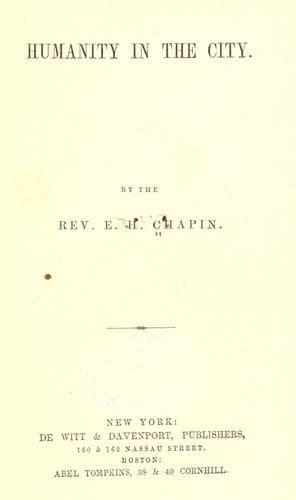
Sermons, American; Universalist Church of America -- Sermons
But a solution of this problem, clearer perhaps than any other, appears
when we consider another lesson of the street; a lesson which requires
us to look a little deeper, but which, when we do look, is no less
evident than these diversities. That lesson unfolds the essential
_unity_ of humanity. For, we find that the differences between men are
_formal_ rather than _real_; that, with various outward conditions, they
pass through the same great trials; and that the scales which seem to
hang uneven at the surface, and to be tipped this way and that by the
currents of worldly fortune, are very nearly balanced in the depths of
the inner life. We are shallow judges of the happiness or the misery of
others, if we estimate it by any marks that distinguish them from
ourselves; if, for instance, we say that because they have more money
they are happier, or because they live more meagrely they are more
wretched. For, men are allied by much more than they differ. The rich
man, rolling by in his chariot, and the beggar, shivering in his rags,
are allied by much more than they differ. It is safer, therefore, to
estimate our neighbor's real condition by what we find in our own lot,
than by what we do not find there. And now, see into what an essential
unity this criterion draws the jostling, divergent masses in yonder
street! Each man there, like all the rest, finds life to be a
discipline. Each has his separate form of discipline; but it bears upon
the kindred spirit that is in every one of us, and strikes upon motives,
sympathies, faculties, that run through the common humanity. Surely, you
will not calculate any _essential_ difference from mere appearances; for
the light laughter that bubbles on the lip often mantles over brackish
depths of sadness, and the serious look may be the sober veil that
covers a divine peace. You know that the bosom _can_ ache beneath
diamond brooches, and how many blithe hearts dance under coarse wool.
But I do not allude merely to these accidental contrasts. I mean that
about equal measures of trial, equal measures of what men call good and
evil, are allotted to all; enough, at least, to prove the identity of
our humanity, and to show that we are all subjects of the same great
plan. You say that the poor man who passes yonder, carrying his burden,
has a hard lot of it, and it may be he has; but the rich man who brushes
by him has a hard lot of it too--just as hard for _him_, just as well
fitted to discipline him for the great ends of life. He has his money
to take care of; a pleasant occupation, you may think; but, after all,
an _occupation_, with all the strain and anxiety of labor, making more
hard work for him, day and night, perhaps, than his neighbor has who
digs ditches or thumps a lapstone. And it is quite likely that he feels
poorer than the poor man, and, if he ever becomes self-conscious, has
great reason to feel meaner. And then, he has his rivalries, his
Public-domain text, read in full here on John Shaqi.
Reviews
Reviews
No reviews yet
Be the first to share your thoughts on this work.
Join the Discussion
Join the discussion
Sign in to leave a comment or review.
Sign InorCreate an account