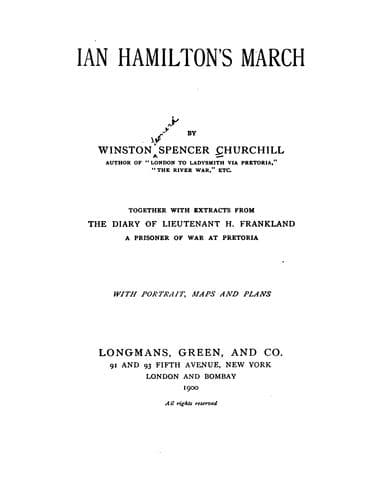
Hamilton, Ian, Sir, 1853-1947; South African War, 1899-1902
Ladysmith, her garrison and her rescuers, were still recovering, the one
from the effects of long confinement, the other from over-exertion. All
was quiet along the Tugela except for the plashing of the waters, and
from Hunger’s Poorte to Weenen no sound of rifle or cannon shot
disturbed the echoes.
The war had rolled northward: the floods of invasion that had
isolated--almost overwhelmed--Ladysmith and threatened to submerge the
whole country had abated and receded, so that the Army of Natal might
spread itself out to feed and strengthen at its leisure and convenience
on the reconquered territory.
Knox’s (Ladysmith) Brigade went into camp at Arcadia, five miles west of
the town. Howard’s (Ladysmith) Brigade retired to the breezy plains
south of Colenso. Clery’s Division--for the gallant Clery, recovered
from his sickness, had displaced the gallant and successful
Lyttelton--moved north and encamped beyond Elandslaagte along the banks
of Sunday’s River. Hunter’s Division was disposed with one brigade at
Elandslaagte and one at Tinta Inyoni. Warren, whom it was no longer
necessary to send to the Cape Colony, established himself and his two
brigades north of Ladysmith, along the railway line to the Orange Free
State. Brocklehurst, with the remnants of what had once been almost a
Cavalry Division, and now could scarcely mount three squadrons, occupied
a neighbouring plain, sending his regiments one by one to Colenso, or
even Mooi River, to be re-horsed; and around all this great Army,
resting after its labours and preparing for fresh efforts, the Cavalry
brigades of Dundonald and Burn-Murdoch drew an immense curtain of
pickets and patrols which extended from Acton Homes in the east, through
Bester’s Station right round to Wessels Nek and further still, and which
enabled the protected soldiers within to close their eyes by night and
stretch their legs by day.
Meanwhile, the burghers had all retreated to the Drakensburg and the
Biggarsburg and other refuges, from which elevated positions they defied
intrusion or attack, and their scattered line stretched in a vast
crescent even around our widely extended front from the Tintwa Pass,
through Waschbank to Pomeroy.
But with the exception of outpost skirmishes, wholly unimportant to
those not engaged in them, a strange peace brooded over Natal, and
tranquillity was intensified by the recollection of the struggle that
was over and the anticipation of the struggle that impended. It was a
lull in the storm.
All this might be war, but it was not journalism. The tempest for the
moment had passed, and above the army in Natal the sky was monotonously
blue. It was true that dark clouds hung near the northern horizon, but
who should say when they would break? Not, at any rate, for three weeks,
I thought, and so resolved to fill the interval by trying to catch a
little of the tempest elsewhere.
Public-domain text, read in full here on John Shaqi.
Reviews
Reviews
No reviews yet
Be the first to share your thoughts on this work.
Join the Discussion
Join the discussion
Sign in to leave a comment or review.
Sign InorCreate an account