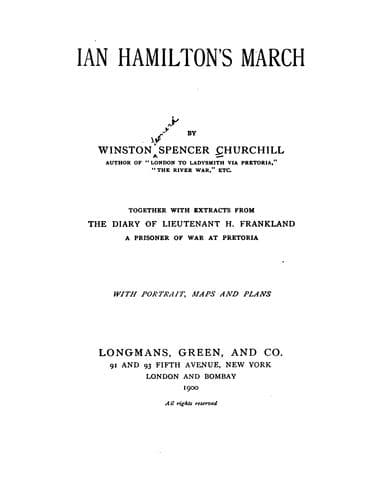
Hamilton, Ian, Sir, 1853-1947; South African War, 1899-1902
After the relief of Ladysmith four courses offered themselves to Sir
Redvers Buller. To stand strictly on the defensive in Natal and to send
Lord Roberts every gun and man who could be spared; to break into the
Free State by forcing Van Reenen’s Pass or the Tintwa; to attack the
twelve thousand Boers in the Biggarsburg, clear Natal, and invade the
Transvaal through the Vryheid district; and, lastly, to unite and
reorganise and co-operate with Lord Roberts’s main advance either by
striking west or north.
Which course would be adopted? I made inquiries. Staff officers, bland
and inscrutable--it is wonderful how well men can keep secrets they have
not been told--continued to smile and smile. Brigadiers frankly
confessed their ignorance. The general-in-chief observed pleasantly
that he would ’go for’ the enemy as soon as he was ready, but was
scarcely precise about when and where.
It was necessary to go to more humble sources for truth, and after
diligent search I learned from a railway porter, or somebody like that,
that all attempts to repair the bridge across the Sunday’s River had
been postponed indefinitely. This, on further inquiry, proved to be
true.
Now, what does this mean? It means, I take it, that no direct advance
against the Biggarsburg is intended for some time; and as the idea of
reducing the Natal Army to reinforce the Cape Colony forces has been
definitely abandoned the western line of advance suggests itself.
It would be absurd to force Van Reenen’s Pass with heavy loss of life,
when by waiting until the main Army has reached, let us say, Kroonstad,
we could walk through without opposition; so that it looks very likely
that the Natal troops will do nothing until Lord Roberts’s advance is
more developed, and that then they will enter the Free State and operate
in conjunction with him, all of which is strategy and common-sense
besides. At any rate there will be a long delay.
Therefore, I said to myself, I will go to Bloemfontein, see all that may
be seen there and on the way, and rejoin the Natal Army when it comes
through the passes. Such was the plan, and the reader shall be a
witness of its abandonment.
I left the camp of Dundonald’s Brigade early in the morning of the 29th
of March, and riding through Ladysmith, round the hill on which stands
the battered convent, now serving as headquarters, and down the main
street, along which the relieving Army had entered the city, reached the
railway station and caught the 10 A.M. down train.
We were delayed for a few minutes by the departure for Elandslaagte of a
train load of Volunteers, the first to reach the Natal Army, and the
officers hastened to look at these citizen soldiers. There were five
companies in all, making nearly a thousand men, fine looking fellows,
with bright intelligent eyes, which they turned inquiringly on every
object in turn, pointing and laughing at the numerous shell holes in the
corrugated iron engine sheds and other buildings of the station.
Public-domain text, read in full here on John Shaqi.
Reviews
Reviews
No reviews yet
Be the first to share your thoughts on this work.
Join the Discussion
Join the discussion
Sign in to leave a comment or review.
Sign InorCreate an account