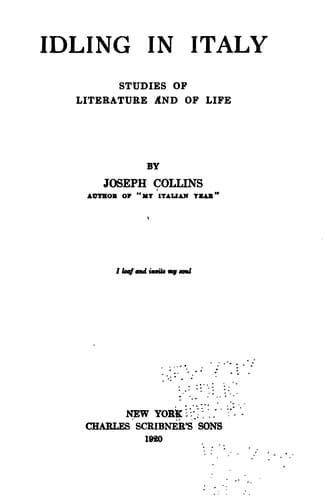
Idling in Italy: Studies of literature and of lifeCollins, Joseph
History
Idling in Italy: Studies of literature and of life
Collins, Joseph
Italian literature -- History and criticism
Death has claimed nearly all of the conspicuous figures of literature in
the period of the risorgimento. One who had a strange tenacity of life,
which he but recently yielded, was Salvatore Farina, whose first
romances, "Un Segreto" ("A Secret") and "Due Amori" ("Two Loves"), were
published more than fifty years ago. He was, perhaps, the truly
representative writer of the Piccolo Borghese in the generation that
followed Italy's unity. In the fifty or more volumes that he published
(the last of which appeared in 1912 and was called the "Second Book of
the Lovers") he portrayed a variety of romanticism which was the
outgrowth of the struggle between the drab and commonplace realities of
life and the fantastic dreams of simple-minded persons who thought that
life would be ideal if it could be fashioned after their own plans. He
was the novelist of sickly sentiment, the most slavish disciple that
Samuel Richardson ever had. Students of Italian literature will read his
two reminiscent volumes called "La mia Giornata," the first published in
1910, the second in 1913, to get a picture of the literary doings of one
of the grayest and most uncertain periods of modern Italian literature.
He is mentioned here merely to note the tremendous popularity which his
writings had, and to call attention to the fact that they left no
impression upon the times and that the type of novel which they
represent has practically now disappeared the world over.
CHAPTER II
LITERARY ITALY
(CONTINUED)
Among the interesting literary figures of the old school still living is
Renato Fucini, whose pen-name is Neri Tanfucio. He is now nearly eighty
years old, and for some years has been living in a small town not far
from Florence, writing his recollections. In college he studied civil
engineering, but he soon forsook it and secured employment in the office
of the Municipal Art Direction in Florence. Later he taught Italian in
the technical school at Pistoia and after that was several years an
inspector of rural schools. It was during these years of wandering
through Tuscany that he got the intimate knowledge of its simple,
industrial, pleasure-loving people, peasant and poacher, landlord and
inspector, teacher and pupil, that he has embodied in his stories and in
his burlesque, tragic, and sentimental verses.
Public-domain text, read in full here on John Shaqi.
Reviews
Reviews
No reviews yet
Be the first to share your thoughts on this work.
Join the Discussion
Join the discussion
Sign in to leave a comment or review.
Sign InorCreate an account