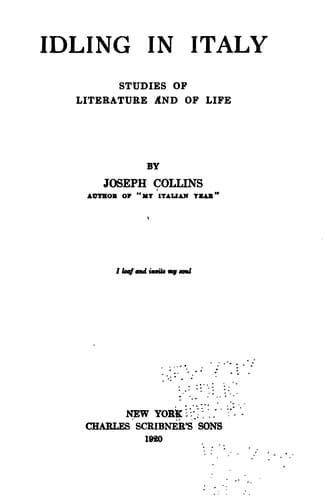
Idling in Italy: Studies of literature and of lifeCollins, Joseph
History
Idling in Italy: Studies of literature and of life
Collins, Joseph
Italian literature -- History and criticism
Grazia Deledda has done for her native island of Sardinia that which
Signora Serao did for Naples, but to a great extent she kept lubricity
out of her writings. In her "Il Vecchio della Montagna" ("The Old Man of
the Mountain"), "La Via del Male" ("Road to Evil"), "Cenere" ("Ashes"),
"Nostalgia," "L'Incendio nell' Uliveto" ("The Burning in the Olive
Grove"), and many others, she depicted with wondrous accuracy the life,
feelings, struggles, ambitions, infirmities of the Sardinians, and
painted their sordid surroundings and glorious scenery. She did for that
wonderful island, so strangely neglected by the mother country, what
Mary Wilkins did for New England. Her imagination was never so vivid nor
was her eye so penetrating as that of her Neapolitan sister, nor has she
known the voluptuous side of life, seamy or embroidered, but she has
known how to put down in a way that engrosses the reader's attention the
pitiable and pathetic plights that circumstance and passion force upon
the people with whom she lives. The display of their passions and
sorrows are apparently as familiar to her as the landscapes.
Unfortunately, however, she does for them that which she does for the
latter. She idealizes them or, better said, she strains them through her
imagination. In other words, instead of recording them as they are she
records them as they should be. Her novels give the impression of being
photographic until you read Verga. Not that the breath of insincerity
which Croce said was the curse of Italy's modern writers comes from her.
She is most sincere, but her characters are sandman manikins into whose
nostrils she has breathed the breath of life. She makes her characters
do what she might do if she were one of them.
Whether she is tugging at the end of her intellectual tether or not
remains to be seen, but her recent work has not the spontaneity and
imaginativeness of her earlier books and she is almost obsessed with
describing landscapes, the advent and departure of the sun, and
stage-settings generally. Her last story, "The Burning in the Olive
Grove," is a conflict between the present and the past, and turns upon a
marriage of convention. It gives the author the opportunity to depict
the imperious eighty-three-year-old grandmother, her useless brother,
the farm lassie whose worldly success in marrying into a family above
her station she owes to her beauty, and a pillar of feminine virtue who
would live her own life in her own way despite the schemings of the
grandmother of feudalistic behavior. The scene is filled with character
studies which she likes so well: the old soldier of Garibaldi's legion,
his lame son whom the heroine loves, and virtuous heroic peasantry.
Public-domain text, read in full here on John Shaqi.
Reviews
Reviews
No reviews yet
Be the first to share your thoughts on this work.
Join the Discussion
Join the discussion
Sign in to leave a comment or review.
Sign InorCreate an account