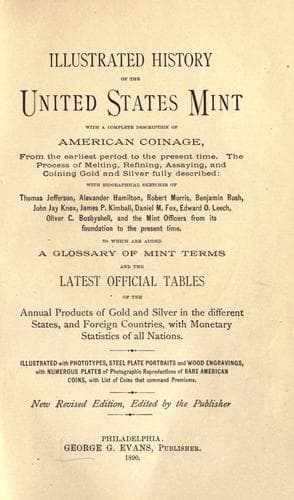
Illustrated history of the United States mint: with a complete description of American coinage, from the earliest period to the present time
History
Illustrated history of the United States mint: with a complete description of American coinage, from the earliest period to the present time
Coinage -- United States; Mints -- United States
Silver is next weighed out for the quartation (alloying), and as the
assay piece, if standard, should contain 900-thousandths of gold, there
must be three times this weight, or 2700-thousandths of silver; and this
is the quantity used. The lead used for the cupellation is kept prepared
in thin sheets, cut in square pieces, which should each weigh about ten
times as much as the gold under assay. The lead is now rolled into the
form of a hollow cone; and into this are introduced the assay gold and
the quartation silver, when the lead is closed around them and pressed
into a ball. The furnace having been properly heated, and the cupels
placed in it and brought to the same temperature, the leaden ball, with
its contents, is put into a cupel (a small cup made of burned bones,
capable of absorbing base metals), the furnace closed, and the operation
allowed to proceed, until all agitation is ceased to be observed in the
melted metal, and its surface has become bright. This is an indication
that the whole of the base metals have been converted into oxides, and
absorbed by the cupel.
The cupellation being thus finished, the metal is allowed to cool slowly,
and the disc or button which it forms is taken from the cupel. The button
is then flattened by a hammer; is annealed by bringing it to a red heat;
is laminated by passing it between the rollers; is again annealed; and
is rolled loosely into a spiral or coil called a _cornet_. It is now
ready for the process of quartation. This was formerly effected in a
glass matrass, and that mode is still used occasionally, when there
are few assays. But a great improvement, first introduced into this
country by the Assayer in 1867, was the—“platinum apparatus,” invented
in England. It consists of a platinum vessel in which to boil the nitric
acid, which is to dissolve out the silver, and a small tray containing
a set of platinum thimbles with fine slits in the bottom. In these the
silver is taken out, by successive supplies of nitric acid, without any
decanting as in the case of glass vessels. The cornets are also annealed
in the thimbles; in fact there is no shifting from the coiling to the
final weighing, which determines the fineness of the original sample by
proportionate weights in thousandths. In this process extra care has to
be taken in adding the proportions of silver, as the “shaking” of any one
cornet, might damage the others.
ASSAYING SILVER.
Public-domain text, read in full here on John Shaqi.
Illustrated history of the United States mint: with a complete description of American coinage, from the earliest period to the present time — John Shaqi
Reviews
Reviews
No reviews yet
Be the first to share your thoughts on this work.
Join the Discussion
Join the discussion
Sign in to leave a comment or review.
Sign InorCreate an account