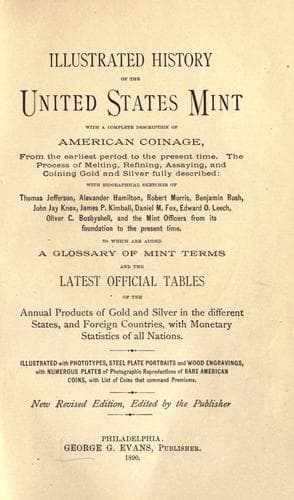
Illustrated history of the United States mint: with a complete description of American coinage, from the earliest period to the present time
History
Illustrated history of the United States mint: with a complete description of American coinage, from the earliest period to the present time
Coinage -- United States; Mints -- United States
The process of assaying silver differs from that of gold. To obtain the
assay sample, a little of the metals is dipped from the pot and poured
quickly into water, producing a granulation, from portions of which that
needed for assay is taken. In the case of silver alloyed with copper
there is separation, to a greater or less degree, between the two metals
in the act of solidification. Thus an ingot or bar, cooled in a mould,
or any single piece cut from either, though really 900-thousandths fine
on the average, will show such variations, according to the place of
cutting, as might exceed the limits allowed by law. But the sudden chill
produced by throwing the liquid metal into water, yields a granulation of
entirely homogeneous mixture that the same fineness results, whether by
assaying a single granule, or part of one, or a number.
From this sample the weight of 1115 thousandths is taken; this is
dissolved in a glass bottle with nitric acid. The standard solution of
salt is introduced and chloride of silver is the result, which contains
of the metallic silver 1000 parts; this is repeated until the addition
of the salt water shows but a faint trace of chloride below the upper
surface of the liquid. For instance: if three measures of the decimal
solution have been used with effect, the result will show that the 1115
parts of the piece contained 1003 of pure silver; and thus the proportion
of pure silver in the whole alloyed metal is ascertained. Extensive
knowledge and experience are required in such matters as making the
bone-ash cupels, fine proof gold and silver, testing acids, and other
special examinations and operations. The Assayer must, himself, be
familiar with all the operations of minting, as critical questions are
naturally carried to him. The rendering of decisions upon counterfeit
or suspicious coins has long been a specialty in this department. Once a
year the President appoints a scientific commission to examine the coins
of the preceding year. There has never yet been a Philadelphia coin found
outside of the tolerance of fineness.
THE SEPARATING ROOM.
This department occupies the largest part of the west side of the
building, on the second floor. Here the gold and silver used by the Mint
in the manufacture of coin and fine bars are separated from each other,
or whatever other metals may be mixed with them, and purified. It goes to
this room after having been once melted and assayed. In separating and
purifying gold, it is always necessary to add to it a certain quantity of
pure silver. The whole is then immersed in nitric acid, which dissolves
the silver into a liquid which looks like pure water. The acid does not
dissolve the gold, but leaves it pure. The silver solution is then drawn
off, leaving the gold at the bottom of the tub. It is then gathered up
into pans and washed.
Public-domain text, read in full here on John Shaqi.
Reviews
Reviews
No reviews yet
Be the first to share your thoughts on this work.
Join the Discussion
Join the discussion
Sign in to leave a comment or review.
Sign InorCreate an account