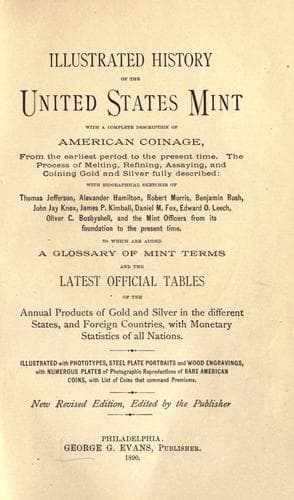
Illustrated history of the United States mint: with a complete description of American coinage, from the earliest period to the present time
History
Illustrated history of the United States mint: with a complete description of American coinage, from the earliest period to the present time
Coinage -- United States; Mints -- United States
After being stamped the coins are taken to the Coiner’s room, and placed
on a long table—the double eagles in piles of ten each. It will be
remembered that, in the Adjusting Room, a difference of one-half a grain
was made in the weight of some of the double eagles. The light and heavy
ones are kept separate in coining, and when delivered to the treasurer,
they are mixed together in such proportions as to give him full weight
in every delivery. By law the deviation from the standard weight, in
delivering to him, must not exceed three pennyweights in one thousand
double eagles. The gold coins—as small as quarter eagles being counted
and weighed to verify the count—are put up in bags of $5,000 each. The
three-dollar pieces are put up in bags of $3,000, and one-dollar pieces
in $1,000 bags. The silver pieces, and sometimes small gold, are counted
on a very ingenious contrivance called a “counting-board.”
[Illustration: COUNTING BOARD.]
By this process twenty-five dollars in five-cent pieces can be counted
in less than a minute. The “boards” are a simple flat surface of wood,
with copper partitions, the height and size of the coin to be counted,
rising from the surface at regular intervals, and running parallel with
each other from top to bottom. They somewhat resemble a common household
“washing board,” with the grooves running parallel with the sides but
much larger. The boards are worked by hand, over a box, and as the pieces
are counted they slide into a drawer prepared to receive them. They are
then put into bags and are ready for shipment.[8]
THE CABINET.
Public-domain text, read in full here on John Shaqi.
Reviews
Reviews
No reviews yet
Be the first to share your thoughts on this work.
Join the Discussion
Join the discussion
Sign in to leave a comment or review.
Sign InorCreate an account