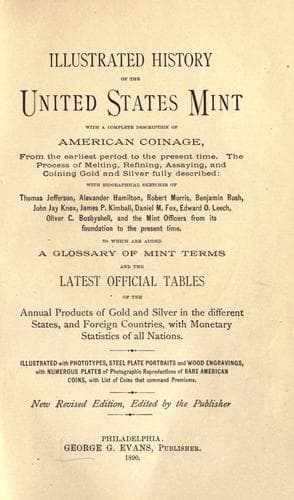
Illustrated history of the United States mint: with a complete description of American coinage, from the earliest period to the present time — John Shaqi
Illustrated history of the United States mint: with a complete description of American coinage, from the earliest period to the present time
History
Illustrated history of the United States mint: with a complete description of American coinage, from the earliest period to the present time
Coinage -- United States; Mints -- United States
The room in the Mint used for the Cabinet is on the second floor. It was
formerly a suite of three apartments connected by folding-doors, but the
doors have been removed, and it is now a pleasant saloon fifty-four feet
long by sixteen wide. The eastern and western sections are of the same
proportions, each with a broad window. The central section is lighted
from the dome, which is supported by four columns. There is an open space
immediately under the dome, to give light to the hall below, which is the
main entrance to the Mint. Around this space is a railing and a circular
case for coins. The Cabinet of Coins was established in 1838, by Dr. R.
M. Patterson, then Director of the Mint. Anticipating such a demand,
reserves had been made for many years by Adam Eckfeldt,[9] the Coiner,
of the “master coins” of the Mint; a term used to signify first pieces
from new dies, bearing a high polish and struck with extra care. These
are now more commonly called “proof pieces.” With this nucleus, and a
few other valuable pieces from Mr. Eckfeldt, the business was committed
to the Assay Department, and especially to Mr. Du Bois, Assistant
Assayer. The collection grew, year by year, by making exchanges to supply
deficiencies, by purchases, by adding our own coin, and by saving foreign
coins from the melting-pot—a large part in this way, at a cost of not
more than their bullion value, though demanding great care, appreciation,
and study. Valuable donations were also made by travelers, consuls, and
missionaries. In 1839, Congress appropriated the sum of $1,000 for the
purchase of “specimens of ores and coins to be preserved at the Mint.”
Annually, since, the sum of $300 has been appropriated by the Government
for this object. More has not been asked or desired, for the officers of
the Mint have not sought to vie with the long established collections of
the national cabinets of the old world, or even to equal the extravagance
of some private numismatists; but they have admirably succeeded in their
purpose to secure such coins as would interest all, from the schoolboy to
the most enthusiastic archæologist. The economic principle upon which the
collection has been gathered is a lesson to all governmental departments
in frugality, as well as a restraint upon the natural tendency to
extravagance which has heretofore distinguished those who have a passion
for old coins. There are thousands of coin collectors in the United
States, and fortunes have been accumulated in this strange way. More than
one authenticated instance has been known in this country where a man
has lived in penury, and died from want, yet possessed of affluence in
time-defaced coins.
RELICS.
Having referred to the portraits of the Directors of the Mint, we will
cite other interesting subjects of observation, before describing the
coins.
Public-domain text, read in full here on John Shaqi.
Reviews
Reviews
No reviews yet
Be the first to share your thoughts on this work.
Join the Discussion
Join the discussion
Sign in to leave a comment or review.
Sign InorCreate an account