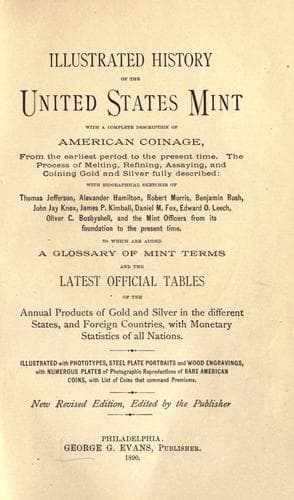
Illustrated history of the United States mint: with a complete description of American coinage, from the earliest period to the present time
History
Illustrated history of the United States mint: with a complete description of American coinage, from the earliest period to the present time
Coinage -- United States; Mints -- United States
The first object in the Cabinet attracting attention is a framed copy of
the law of Congress establishing the Mint, with its quaint phraseology
with the signature of Thomas Jefferson. (See fac simile on page 11.)
In the first section, near the western window, is the assorting machine,
the invention of a Frenchman, Baron Seguier, and which is now in use in
the Mint at Paris.
The planchets for coinage are liable to be a little too heavy or too
light; it is therefore necessary, at least in the case of gold, to assort
them by weighing. This machine is designed to enable one person to do
the work of many. “The planchets are thrown into the hopper at the rear,
and, being arranged by the action of the wheel, slide down balances. By
machinery beneath they are carried one by one to the nearest platforms to
be weighed. If too heavy, the tall needle of the beam leans to the right
and lifts a pallet-wire, which connects with an apparatus under the table
by which the planchet is pushed off and slides into one of the brass pans
in front. If the piece be light, the needle is drawn over to the left,
and touches the other pallet, which makes a passage to another brass
pan. If the piece be of true weight, or near enough, the needle stands
perpendicular between the pallets, and the piece finds its way into the
third brass pan.”
On the opposite wall is a fine cast of Cromwell, a duplicate of one
taken shortly after his death. It was placed here by Mr. W. E. Du Bois,
who received it from H. W. Field, Esq., late Assayer of the Royal Mint,
London, who is a descendant of the great Protector. Below the cast of
Cromwell is a case showing progressive “alloys of gold.” The plates
comprise gold alloyed with copper, gold alloyed with silver, and gold
fine.
In the eastern section are the Standard Test Scales, used to test the
weights sent to all the mints and assay offices in the United States, and
are so delicate as to weigh the _twenty-thousandth_ part of an ounce.
These scales were manufactured by employees of the Mint, and have been
in use more than a quarter of a century. The beam is hollow, and filled
with Spanish cedar to guard against the effect of dampness; the bearings
are edges of knife-blades, which impinge on a surface of agate plate.
These scales are tested by the Annual Assay Committee, which meets on the
second Tuesday in February of every year.
CURIOSITIES AND MINERALS.
Public-domain text, read in full here on John Shaqi.
Reviews
Reviews
No reviews yet
Be the first to share your thoughts on this work.
Join the Discussion
Join the discussion
Sign in to leave a comment or review.
Sign InorCreate an account