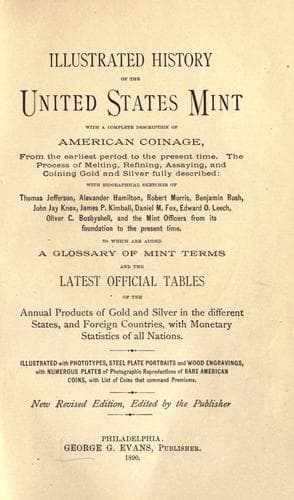
Illustrated history of the United States mint: with a complete description of American coinage, from the earliest period to the present time
History
Illustrated history of the United States mint: with a complete description of American coinage, from the earliest period to the present time
Coinage -- United States; Mints -- United States
The most interesting objects of this curious display are three golden
images from graves in the Island of Chiriqui, off Central America. They
were dug up in 1858, and sent to the Mint as bullion, to be melted. They
are of pure gold, but the workmanship is very crude. The images are in
the forms of a reptile, a bird, and a man with symbols of power in his
hands, not unlike those designating Jupiter. There are also, in the first
section, two large cases with choice selections of mineral specimens,
carefully classified and labeled. These are from well selected results of
years of patient collecting, and are deserving of more study than can be
devoted to them by casual visitors. They are chiefly from different parts
of the United States, and are an “index book” to the vast mineral wealth
of the nation.
Near the exit door of the Cabinet, in a large glass case, is a
magnificent American eagle, which is worthy of the visitor’s attention.
It is superbly mounted, with grand breadth of wing and wondrous piercing
eyes. The portrait of this “pet” can be recognized on Reverse of the
“Pattern” Silver Dollars of 1836, 1838, and 1839, and on the Obverse of
the first nickel cent pieces coined in 1856.
“PETER,”
the name which the noble bird recognized, was an inhabitant of the Mint
six years. He would fly about the city, but no one interfered with the
going or coming of the “Mint bird,” and he never failed to return from
his daily exercise before the time for closing the building. In an evil
hour he unfortunately perched upon a large fly wheel, and getting caught
in the machinery, received a fatal injury to his wing, and this ended
rather an unusual career for an eagle.
EASTERN CORRIDOR.
Opening into the eastern corridor are the rooms of the Superintendent,
the Chief Clerk, and the library of Historical and Scientific Works,
including many valuable books upon the art of coinage. Passing out
upon the gallery, we enter the Machinists’ and Engravers’ rooms.
Here are engraved and finished the dies used in this Mint and in all
the branch mints. Visitors are not ordinarily allowed access to these
rooms, or to the assay office, or to the cellar. (In the latter are a
number of immense vaults, and in the main cellar are engines, which
supply the power and light used throughout the building.) Here are also
blacksmith, carpenter, and paint shops; and in the rear, west side, is
the medal-striking room, where medals are struck by a screw press, worked
by hand. The cellar also contains the “sweep” grinding rooms. Near this
room are the wells, which are receptacles for the water used in washing
the precious metals. These wells are cleaned out every few years and the
deposit is then treated in the same way as the sweepings.
Public-domain text, read in full here on John Shaqi.
Reviews
Reviews
No reviews yet
Be the first to share your thoughts on this work.
Join the Discussion
Join the discussion
Sign in to leave a comment or review.
Sign InorCreate an account