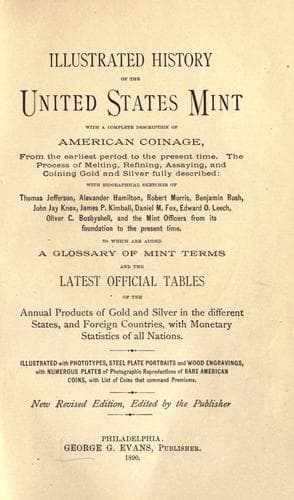
Illustrated history of the United States mint: with a complete description of American coinage, from the earliest period to the present time
History
Illustrated history of the United States mint: with a complete description of American coinage, from the earliest period to the present time
Coinage -- United States; Mints -- United States
The little wooden building in the court was formerly the cent-room, where
copper cents were exchanged for nickels;[10] it is now the office of the
agent of the Adams Express Company, who brings to the Philadelphia Mint
millions of dollars worth of precious metals in the shape of bullion
from the far west, to be converted into American Coin, when it is
again transported by the same company to various points to be put into
circulation.
COINS.
The ancient coins are chiefly arranged in upright cases against the
walls in the doorways and the middle section of the saloon. The modern
coins are placed in nearly level cases at either end of the room and
in the circular or central cases. Of antique coins the portion labeled
Cabinet Nos. 97, 98, 99, “Massilia,” are interesting as belonging to a
Greek colony which settled about six hundred years before Christ upon the
coast of Gaul, on the spot now known as Marseilles. This little colony
fled their native country and the rule of a governor placed over it by a
Persian monarch. They were distinguished for their civilization, and the
work upon these small coins is the most palpable witness of that fact in
existence to-day.
GREEK COINS.
Their surfaces, of gold, silver, and bronze, bristle with lance and
spear, helmet and shield. On one of these coins Jove is seated and
bearing an eagle, defying Alexander of Macedon, while on the obverse the
same mighty conqueror impersonates Hercules. The oldest coin here is
supposed to date back to 550 B.C. It is well to mention the fact that
coins were never dated until the fifteenth century; and previous to
that time the ages of coins can only be determined by the legends upon
them, as answering to the page of corroborative history and the art era
to which they belonged. No. 9 bears on the obverse the Macedonian horse,
a favorite animal, which the then war-loving Greeks are said to have
deified. At this period the haughty royal families began to chronicle in
coin their line of descent. The kings of Macedon claimed Hercules for
an ancestor, and in proof thereof the lion’s skin was a royal insignia.
An old historian says, “The kings of Macedon, instead of the crown, the
diadem, the purple, bear upon their effigy the skin of a lion.” Several
pieces of money in this case, upon which are heads of Alexander, have
rings in them, and were worn by gracious dames as ornaments. The value
of this series of coins is priceless, as furnishing portraits of the
heroes of that period which can be received without question as accurate,
for the art patronage of the kingdom was regulated by the strictest
laws. Alexander was especially jealous of how the future nations should
regard his physique, allowing only three artists, during his reign,
the privilege of drawing, painting, or modeling his head.[11] To such
royal guardianship may be attributed the perfection to which Greek art
attained; and it may well be a matter of regret that the same firmness in
this regard was not universal.
Public-domain text, read in full here on John Shaqi.
Reviews
Reviews
No reviews yet
Be the first to share your thoughts on this work.
Join the Discussion
Join the discussion
Sign in to leave a comment or review.
Sign InorCreate an account