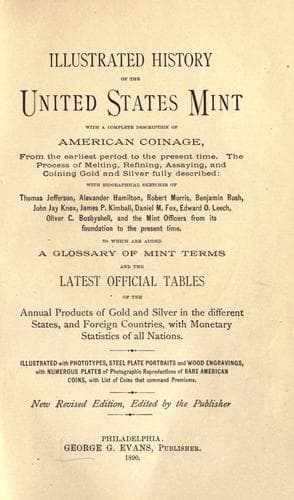
Illustrated history of the United States mint: with a complete description of American coinage, from the earliest period to the present time
History
Illustrated history of the United States mint: with a complete description of American coinage, from the earliest period to the present time
Coinage -- United States; Mints -- United States
The last coin of this series is a small
bronze coin, and was issued by Perseus, the last king of Macedon.
PERSIAN.
In this case is a collection of Persian coins, very choice, and of no
mean workmanship, and, of course, portraying the faith and rites of the
fire-worshippers. One era is distinctly Greek in style, and marks the
period of Greek supremacy. The oldest gold coin known to the collector is
the gold Daric of King Darius, with the head of the king in bold relief;
and all Persian coins are so called in remembrance of this monarch. Their
money was very fine, so the word _Daric_ has become incorporated into
numismatic terminology to designate any pure gold coin. Nos. 58 to 67,
inclusive, of this series, are silver coins of the Sassanian kings.
EGYPT
is also represented in this case, as is proper, for that nation had no
coinage until it was taught the art when conquered by Alexander. Here
are some very attractive data of Egyptian history, and from these coins
are obtained the only portraits of Arsinoe, Cleopatra, and others.
THE SYRIAN COINS
are embraced in the division called “Greek monarchies,” and in them are
found many coins not only important in history, but of the very finest
Greek art, from the third to the first century B.C. In this period the
Syriac and Hebrew coins become intermingled, a fact abundantly sustained
by the Jewish shekel of Simon Maccabees. The legend of this interesting
relic is in the language of Samaria; on one side the budding rod of
Aaron, legend, “Jerusalem the Holy;” on the other, a cup of incense or
pot of manna, and the inscription, “Shekel of Israel.” This shekel is
well preserved, and is one of the most prized coins known. (See Plate and
Case XV., marked “_Selections_.”) In this collection are some coins from
Bactria, considered priceless by savans. These are trophies of recent
British explorations, and are judged to be of sufficient importance
to call forth from an English professor an extended treatise on the
“Antiquities and Coins of Afghanistan.” They are exceedingly rude in
workmanship, and nearly all of baser metal, the most important being a
small, square, brass coin, in the case marked “_Selections_.”
ROMAN COINS.
The collection of Roman coins in this Cabinet numbers nearly one
thousand, and an acquaintance with it is invaluable for object teaching,
as in it is the condensed history, not only of the glory of Rome,
“Mistress of the World,” but of her customs, faith, conquests, wealth,
culture, divisions, and _downfall_. Through this entire section of
time—one-third of the known history of the world—Roman art, though high,
never reached the exalted purity of Greek lines. In their finest coins
we see no Phidias, no Myron, no Praxiteles, but they deteriorate and
fluctuate visibly when in or out of contact with the influence of the
Grecian mind.
GREEK REPUBLIC
Public-domain text, read in full here on John Shaqi.
Reviews
Reviews
No reviews yet
Be the first to share your thoughts on this work.
Join the Discussion
Join the discussion
Sign in to leave a comment or review.
Sign InorCreate an account