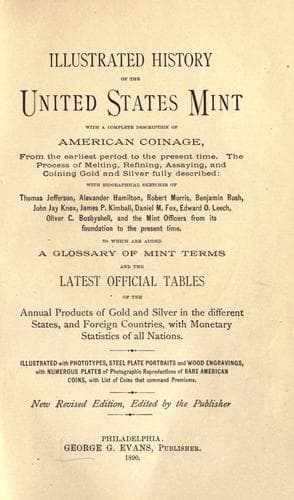
Illustrated history of the United States mint: with a complete description of American coinage, from the earliest period to the present time — John Shaqi
Illustrated history of the United States mint: with a complete description of American coinage, from the earliest period to the present time
History
Illustrated history of the United States mint: with a complete description of American coinage, from the earliest period to the present time
Coinage -- United States; Mints -- United States
will be first in interest, both historic and artistic. It is conceded
that to the Greeks the world owes the introduction of the art of coinage,
and though centuries numbered by tens have passed, some of the old Greek
coins equal many modern productions in purity of lines, and surpass
nearly all in poetic sentiment. On the first coins no earthly potentate
was allowed to be pictured, no deed of heroism portrayed. The glory of
the gods was considered the only appropriate theme for impressions on the
surface of bronze, silver, and gold. The coins of the republic embrace a
large variety, as nearly a thousand towns were allowed the privilege of
coinage. Upon this varied issue are preserved nearly all the legends of
Greek mythology. Upon the coins are the heads of Jupiter, Juno, Minerva,
Bacchus, Apollo, and Diana, with many sacred animals, and the work is
to-day the standard of artistic perfection. Of course, the collection of
this ancient period cannot be extensive. In this case there are, however,
more than one hundred and fifty specimens, and these present a study so
attractive and so intense that it is almost impossible to imagine what
classic poetry would be without it.
Nos. 4, 5, and 6, are silver coins of Ægina, which have on the obverse,
for a device, the tortoise, emblematic of the security of the island amid
the waves, and the protection of the gods of the sea. On the reverse are
the marks of the punches only, probably denoting the value of the coins.
These are claimed to belong to an era seven hundred years before Christ.
No. 28 is a silver coin of Athens, with a head of Minerva splendidly
drawn upon the obverse, while the reverse presents a large owl, the bird
sacred to the goddess of Wisdom. The devices upon this coin indicate its
age to be from twenty-one to twenty-three centuries. The Greek proverb of
“taking owls to Athens” referred to this coin, which was necessarily of
great importance to the tradespeople of that city.
FAMILY COINS.
Public-domain text, read in full here on John Shaqi.
Reviews
Reviews
No reviews yet
Be the first to share your thoughts on this work.
Join the Discussion
Join the discussion
Sign in to leave a comment or review.
Sign InorCreate an account