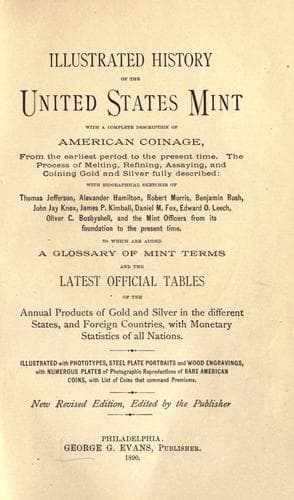
Illustrated history of the United States mint: with a complete description of American coinage, from the earliest period to the present time
History
Illustrated history of the United States mint: with a complete description of American coinage, from the earliest period to the present time
Coinage -- United States; Mints -- United States
These comprise about one hundred and seventy-five, of which one hundred
and twenty-six are in the collection. They were struck to record the
heroic deeds which first introduced any notable ancestor to fame,
and hence are to-day family charts of respectability for many of the
patricians of Rome, albeit some of them have plebeian roots. Be that as
it may, they are as much the trusted patents of aristocracy as is the
“Book of the Peerage” of England. Here are found the same distinctions
between patrician and plebeian which mark all countries, the patricians
being always designated by a symbol of warfare, while the plebeians
were indicated by the tools and instruments of common trade. The more
noticeable of the coins are as follows: No. 16, Acilia; the reverse a
female leaning against a pillar, with a serpent clutched in her right
hand, indicating the wisdom or courage of some ancestor. No. 20, Æmilia;
on the obverse of this curious coin is a figure kneeling by the side
of a camel, presenting an olive branch, from which depends a fillet or
ancient diadem; on the reverse, a figure guiding a triumphal chariot, a
scorpion in the field. Josephus tells us of an invasion of Arabia, and
that Aretus, the king of the country, purchased peace of the Romans for
five hundred talents. The diadem hanging from the olive branch chronicles
the entire humiliation of Aretus, and the scorpion doubtless indicates
the month of the Roman triumph. No. 30, Aquillia, a small silver coin;
the reverse shows a woman kneeling before a soldier. The motto below
the figures (or in the _exergue_ of the coin, as is the art term) is
“_Sicil_.” This commemorates the suppression of a revolt of slaves in
Sicily, which was achieved by Manlius Aquillia. No. 41, Calpurnia, the
family of Cæsar’s noble wife; reverse, a horseman riding at full speed, a
head of wheat above him; legend, L. Piso-Trugi. The coin recalls the fact
that in the year 507 B.C. there was a famine in Rome, and Calpurnius Piso
was dispatched to Africa to buy corn. This seemingly small service is
magnified upon a large number of coins. Nos. 95 and 96, Hostilia, a coin
with a sacrifice to _Pallor_ and _Pavor_ (fear and trembling), offered
by Tullus Hostilius in some great emergency. No. 97, Julia; obverse, a
helmeted head; legend, Cæsar; reverse, a warrior in a chariot drawn by
two horses.
Public-domain text, read in full here on John Shaqi.
Reviews
Reviews
No reviews yet
Be the first to share your thoughts on this work.
Join the Discussion
Join the discussion
Sign in to leave a comment or review.
Sign InorCreate an account