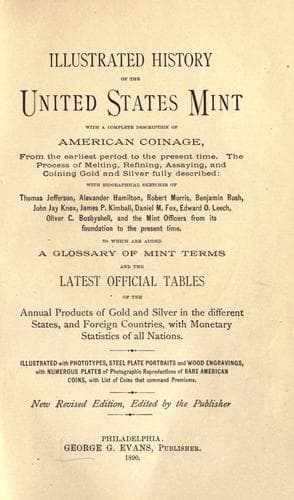
Illustrated history of the United States mint: with a complete description of American coinage, from the earliest period to the present time — John Shaqi
Illustrated history of the United States mint: with a complete description of American coinage, from the earliest period to the present time
History
Illustrated history of the United States mint: with a complete description of American coinage, from the earliest period to the present time
Coinage -- United States; Mints -- United States
The first coins of Great Britain were of tin, according to Cæsar’s
authority, who mentions the “tin money of Britain,” which has lately been
sustained by the discovery, in some work of excavation, of coins of that
metal in antique design. These coins are, however, of little use, by
reason of the obscure inscription, or rather the frequent absence of all
device.
The English collection in the Cabinet begins with a coin made after the
stater of Greece, presenting the head of Minerva, with Greek helmet
on obverse, while the reverse gives the figure of a woman most crudely
drawn. It is supposed this rude attempt at art was coined about the time
of the Roman invasion. Note the contrast presented in placing this relic
by the side of the Victorian sovereign, where, on the obverse, is the
queen’s head superbly cut; on the reverse, Wyon’s inimitable figure of
Una and the Lion. These two coins are the Alpha and the Omega of British
coinage, while the thousands issued between them are progressive links to
civilization.
Two small coins are placed here, thought to be contemporary with the
Christian era, having no device, but an attempt to portray the sun on
one side. No. 2 is the skeattae of Ethelbert I, king of Saxony, and is
the first Saxon coin which has yet been appropriated. It bears upon the
obverse the head of the king; on the reverse is the figure of a bird.
Next in interest is No. 6, the penny of William the Conqueror. The
bust of that famous monarch is attempted; 1068 is about the year it
is supposed to have been made. During the three centuries following,
the condition of England, whether she was at peace or war, is plainly
indicated by her coinage. Every added province is memorialized in coin.
The rose, thistle, and fleur-de-lis, all tell in strange language for
flowers of bloody battles, long sieges, perils by the sea and land; at
last all resistance bowing before the ever-increasing power of Great
Britain.
The first coin of English issue was dated in 1553, being either the close
of Edward VI.’s or the beginning of Queen Mary’s reign. This is claimed
by many to be the first coin dated, though old medals of the preceding
century have been found with date.
In 1558, the ryal or royal of Queen Elizabeth was issued. On the obverse
the queen is grandly enthroned, while the reverse is a large rose, in the
centre of which are the Danish arms of Britain, and the arms of Anjou
quartered. This coin and the pound sterling of Charles I. are in Case
XV., “Selections.”
Public-domain text, read in full here on John Shaqi.
Reviews
Reviews
No reviews yet
Be the first to share your thoughts on this work.
Join the Discussion
Join the discussion
Sign in to leave a comment or review.
Sign InorCreate an account