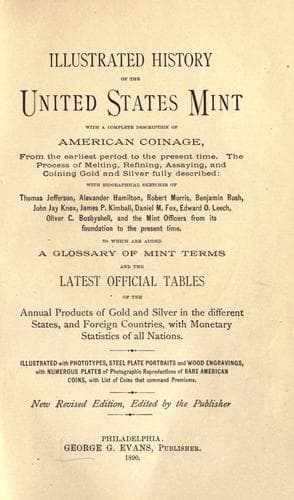
Illustrated history of the United States mint: with a complete description of American coinage, from the earliest period to the present time
History
Illustrated history of the United States mint: with a complete description of American coinage, from the earliest period to the present time
Coinage -- United States; Mints -- United States
This pound sterling is one of the famous “siege pieces” of that unhappy
king,—which were often made on the field with hammer and anvil out of
the family plate brought to the closely-pressed Stuart by his faithful
followers. It is to be regretted that so much valuable family plate of no
mean workmanship was thus sacrificed. This “siege piece” is the largest
silver coin known. The legend upon it, rudely inscribed, is, “Let God
arise; let his enemies be scattered;” above are three fleurs-de-lis, with
date, “1642.”
In 1684-88, during the short reign of James II., several varieties of
new coins were introduced, notably, “Maundy Money,” a small coin made to
be distributed by the king on “Maundy Thursday.” Beggars, on that day,
received from his majesty bags containing as many maundy pieces as the
king had lived years.
King James II. also had issued “gun money.” This variety was made out
of old cannon, after the suppression of an Irish rebellion. Though not
even giving a glance towards the interesting series of Queen Anne, it
is impossible to pass unnoticed the beautiful bust of George IV., by
Chantrey, upon a pattern five-sovereign piece. This well-executed bust of
“the handsomest man in Europe,” was said to be the means of Sir Francis
Chantrey being knighted. That vain monarch was as careful about how his
face would appear to future generations as was Alexander of Macedon; and
Chantrey well knew if he placed upon the shoulders of sixty years the
head of forty years, he had given the cabalistic words which would be the
“open sesame” to royal favor.
The gold sovereign of Victoria, Nos. 183-184, has, on the reverse, an
evidence of coins as a deposit of law archives. The shield surrounded by
a crown, and bearing the arms of Great Britain quartered; but the arms of
Hanover _are omitted_. Although Victoria was next heir to William IV.,
she was prevented by the Salic law from assuming the sceptre of Hanover.
On this coin, it may be remembered, are very beautifully presented the
rose, the thistle, and the shamrock.
A recent addition has been made to the Mint Cabinet of a very fine
sovereign of the times of Oliver Cromwell, purchased at the coin sale of
May 14 and 15, 1885.
Scotch moneys of any variety, are very much prized by collectors (see, in
Case XV., “Selections,” “Groat of Robert Bruce, 1602.”) A very rare coin
is the penny of Robert II. of Scotland, said to be the only specimen in
existence of that monarch’s reign. In the seventeenth century the coinage
of Scotland merged into that of England.
ENGLISH SILVER TOKENS,
Public-domain text, read in full here on John Shaqi.
Reviews
Reviews
No reviews yet
Be the first to share your thoughts on this work.
Join the Discussion
Join the discussion
Sign in to leave a comment or review.
Sign InorCreate an account