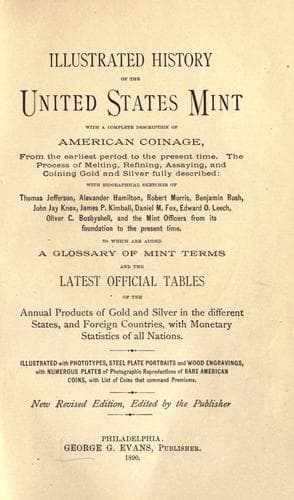
Illustrated history of the United States mint: with a complete description of American coinage, from the earliest period to the present time
History
Illustrated history of the United States mint: with a complete description of American coinage, from the earliest period to the present time
Coinage -- United States; Mints -- United States
issued in England, Scotland, and Ireland. During the long suspension of
specie payments, occasioned by the wars with Napoleon, the minor currency
of England was supplied, not with small paper notes, but with silver
tokens, issued by banks and traders, and made redeemable in bank notes.
They were of reduced weight, to keep within the premium, and to prevent
hoarding. They continued to circulate until the return of better times
and of regular silver coinage. There were many varieties, most of which
are here.
PORTUGAL AND SPAIN.
The coinage of Portugal and Spain in the fifteenth century, held greater
sway than that of other countries. Of their coins, there are many fine
specimens in the Mint Cabinet. The “joe and half-joe[12]” of Portugal are
known of all nations, while the Spanish dollar, with its pretentious two
globes under a crown, did not claim too much, and only tells the almost
limitless rule of the great Philip. The coins of these nations became,
through their possessions in the New World, the circulating medium of
that portion of the earth. Spanish and Mexican dollars were almost
synonymous, while the real and joe of South America was patterned after
that of Portugal, which fact can be learned in this Cabinet. As nations
decay it will be seen their coins become inevitably less trustworthy;
even a glance at the cases marked “Portugal,” “Spain,” will give this
lesson. In the Mexican collection there are issues which seem to
contradict this assertion, for the “Mexican dollar” has, for generations,
had a position in the monetary world of almost unchallenged credit, yet
not by reason of the recognition given Mexico, but because of the _United
States using it so extensively_; for, until the introduction of the
“trade dollar,” this country had _no currency_ that would meet the demand
of the Oriental market.
MEXICO.
The Mexicans use only gold and silver, and their national series is full
of tragic interest, embracing, as it does, three and a half centuries
of Mexican history, from Cortez to Maximilian. The “pillar dollar,”
“windmill dollar,” “cast dollar” (the Mexicans are the only nation that
cast money), and the “cob money” (a series so called by reason of its
clumsiness), are all to be seen in this collection.
COINS OF BRAZIL.
One coin, a gold “half-joe,” issued in 1832, with the infant head of Dom
Pedro, is very beautiful. By the side of this, in every way a contrast
to it, is a series of copper coins of a late issue with the head of the
“child” now seated on the throne. The coins of Bolivia proudly present
the bust of Simon Bolivar. Among the West Indies are many samples of “cut
money.” The law permitting money to be quartered had to be repealed,
because the traders of the West Indies made the wonderful mathematical
discovery that _five quarters_ make a whole!
* * * * *
Public-domain text, read in full here on John Shaqi.
Reviews
Reviews
No reviews yet
Be the first to share your thoughts on this work.
Join the Discussion
Join the discussion
Sign in to leave a comment or review.
Sign InorCreate an account