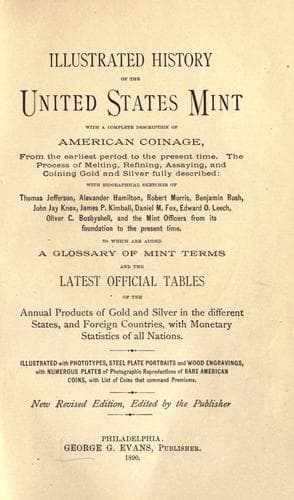
Illustrated history of the United States mint: with a complete description of American coinage, from the earliest period to the present time
History
Illustrated history of the United States mint: with a complete description of American coinage, from the earliest period to the present time
Coinage -- United States; Mints -- United States
Leaving both the eastern and the western world and their coins, there is
a single piece, of small commercial value, which is yet a light-house in
mid-ocean. This is the one cent of the Sandwich Islands, the only venture
of that kind made by the enterprising little kingdom. The inscription
is “Kamehameha III., one hundredth, Hawaii.” The name of the king being
interpreted signifies “the solitary one,” which is singularly well
adapted to the coin.
COLONIAL COINS.
In 1684, the charter of the Massachusetts Bay Company was revoked, and
the governor recalled; one of the alleged grievances by the crown was
a colonial law concerning the Mint. The currency used by the colonies
was chiefly from England, Spain, and Portugal, but the supply was
limited from these sources, and the mother-country was jealous of any
infringement of her prerogative of coinage. There are various specimens
of the “pine-tree” money of Massachusetts in the Cabinet. Some doubt has
arisen as to the species of tree intended, but it is generally accepted
as the emblematic pine. This is claimed to be about the second colonial
issue, a kind of semi-official coin. The first was from the Bermudas.[13]
It is a shilling piece, stamped by one John Hall, silversmith, of the
city of Boston, 1652, who made a very good speculation of the privilege.
There has lately been added to the Cabinet a sixpence of this rare money.
The work on this species of coins is so exceedingly simple as to present
little save a planchet. On the obverse, a double ring around a pine-tree;
legend, “Massachusetts in;” and on the reverse, a double ring also,
containing the legend, “New England An Dom.[14]”
Charles II., it appears, was easily deceived in regard to the
significance of the “pine-tree shilling.” Sir Thomas Temple, a friend
of the colonies, adroitly presented one of these obnoxious coins to the
irate monarch, explaining that the tree was the “royal oak” which had
saved his majesty’s life. Whereupon the king, laughing, denominated his
trans-Atlantic subjects “honest dogs,” and allowed the coinage to proceed.
During the reign of George I. a new species of coin was issued from the
English Mint, denomination half penny, and it is asserted upon good
authority that this was the only issue ever authorized by the home
government for general circulation in the colonies. It was a coin of
mixed metal, resembling brass. The head of the king was on the obverse;
inscription, “Georgius Rex.” The reverse, a large double rose under a
crown; legend, “Rosa Americana.” Upon a scroll, “Utile Dulci.[15]”
Public-domain text, read in full here on John Shaqi.
Reviews
Reviews
No reviews yet
Be the first to share your thoughts on this work.
Join the Discussion
Join the discussion
Sign in to leave a comment or review.
Sign InorCreate an account