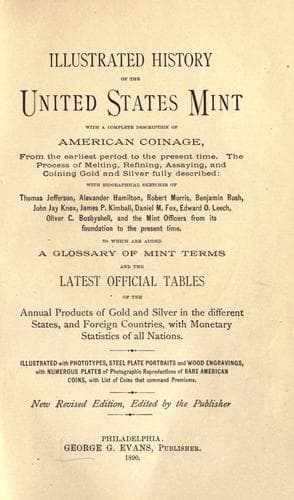
Illustrated history of the United States mint: with a complete description of American coinage, from the earliest period to the present time
History
Illustrated history of the United States mint: with a complete description of American coinage, from the earliest period to the present time
Coinage -- United States; Mints -- United States
The striking of coin between two dies, which were required to accurately
oppose each other, was an operation requiring great dexterity, and the
results were not at all certain. The artisans at this stage of the
work, hit upon the expedient of using both the obverse and reverse die
in a ring of such a size and depth, as to be a guide to each of them.
The balls or disks of metal being struck inside the ring, between the
dies, were forced to assume an even thickness, and a circular form
corresponding with the inside of the ring. After the ring had been used
in this way for some time, it was engraved upon the inside, and the
coins produced were not only circular in shape, but stamped upon their
edges. Thus was produced the perfect coin, and through the introduction
of machinery has secured uniformity in the result and saved an immense
amount of labor in striking vast sums of money; the artistic beauty of
some of the antique specimens has not been surpassed in modern times.
PORTRAITURE UPON COINS.
It is said that no human head was ever stamped upon coins until after
the death of Alexander the Great; he being regarded as somewhat of a
divinity, his effigy was impressed upon money, like that of other gods.
The knowledge of coins and medals, through the inscriptions and devices
thereon, is, to an extent, a history of the world from that date in which
metals were applied to such uses. Events engraven upon these, remain
hidden in tombs or buried in the bosom of the earth, deposited there in
ages long past, by careful and miserly hands, only awaiting the research
of the patient investigator to tell the story of their origin. Numismatic
treasures are scanned as evidence of facts to substantiate statements
upon papyrus or stone, and dates are often supplied to define the border
line between asserted tradition and positive history. Gibbon remarks: “If
there were no other record of Hadrian, his career would be found written
upon the coins of his reign.”
The rudeness or perfection of coins and medals furnish testimony of the
character and culture of the periods of their production. This is equally
true of that rarest specimen of antiquity, the Syracusan silver medal—the
oldest known to collectors—and the latest triumph of the graver’s art in
gold, the Metis medal.
It is not generally known that the rarest portraits of famous heroes
are found upon coins and medals. The historian, especially the historic
artist, is indebted to this source alone for the portraits of Alexander,
Ptolemy, Cleopatra, Mark Antony, Cæsar, and many other celebrities.
Perhaps the valuation of a rare coin or medal may be estimated by
reference to one piece in the Philadelphia Mint. It is an Egyptian coin
as large as a half-eagle, and has on the obverse the head of the wife of
Ptolemy—Arsinoe—the only portrait of her yet discovered.
INCIDENTS OF HISTORY
Public-domain text, read in full here on John Shaqi.
Reviews
Reviews
No reviews yet
Be the first to share your thoughts on this work.
Join the Discussion
Join the discussion
Sign in to leave a comment or review.
Sign InorCreate an account