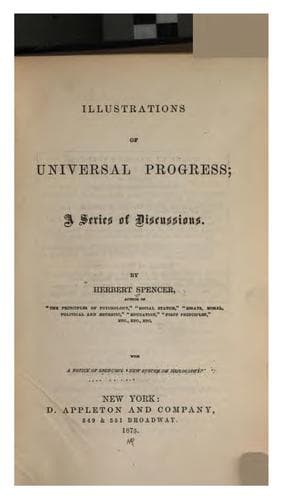
Illustrations of Universal Progress: A Series of DiscussionsSpencer, Herbert
Philosophy
Illustrations of Universal Progress: A Series of Discussions
Spencer, Herbert
Philosophy; Political science; Science
complex religious organization, with its various grades of officials, from
archbishops down to sextons, its colleges, convocations, ecclesiastical
courts, &c.; to all which must be added the ever multiplying independent
sects, each with its general and local authorities. And at the same time
there is developed a highly complex aggregation of customs, manners, and
temporary fashions, enforced by society at large, and serving to control
those minor transactions between man and man which are not regulated by
civil and religious law. Moreover it is to be observed that this ever
increasing heterogeneity in the governmental appliances of each nation, has
been accompanied by an increasing heterogeneity in the governmental
appliances of different nations; all of which are more or less unlike in
their political systems and legislation, in their creeds and religious
institutions, in their customs and ceremonial usages.
[A] For detailed proof of these assertions see essay on _Manners and
Fashion_.
Simultaneously there has been going on a second differentiation of a more
familiar kind; that, namely, by which the mass of the community has been
segregated into distinct classes and orders of workers. While the governing
part has undergone the complex development above detailed, the governed
part has undergone an equally complex development, which has resulted in
that minute division of labour characterizing advanced nations. It is
needless to trace out this progress from its first stages, up through the
caste divisions of the East and the incorporated guilds of Europe, to the
elaborate producing and distributing organization existing among ourselves.
Political economists have long since described the evolution which,
beginning with a tribe whose members severally perform the same actions
each for himself, ends with a civilized community whose members severally
perform different actions for each other; and they have further pointed out
the changes through which the solitary producer of any one commodity is
transformed into a combination of producers who, united under a master,
take separate parts in the manufacture of such commodity. But there are yet
other and higher phases of this advance from the homogeneous to the
heterogeneous in the industrial organization of society.
Public-domain text, read in full here on John Shaqi.
Reviews
Reviews
No reviews yet
Be the first to share your thoughts on this work.
Join the Discussion
Join the discussion
Sign in to leave a comment or review.
Sign InorCreate an account