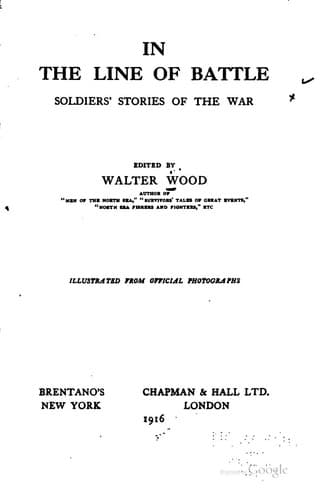
In the Line of Battle: Soldiers' Stories of the War
History
In the Line of Battle: Soldiers' Stories of the War
World War, 1914-1918 -- Personal narratives
The authorities suddenly decided that I should not be exchanged,
because I was a non-commissioned officer, and I was sent to Wesel on
the Rhine, where I stayed six weeks. I had to go into hospital again,
because my wound would not heal--it never got a sporting chance. Ill
treatment continued, and for reasons, mostly revenge, which Britishers
would scorn. The chief of this hospital was an old man whose only son
had been lost in a submarine that had been sunk by the British. I saw
that something was wrong as soon as he appeared in the morning, and I
felt that we should get it hot, though I did not know how.
The old doctor had all the English prisoners sent for, and incredible
as it may seem, every wound that was healed was deliberately reopened
and plugged, while wounds that were not healed were probed inside and
all the newly-formed flesh was destroyed. Many of us suffered terribly
for a long time as the result of the visit to us of the old man who had
lost his son in fair fight.
My wound was finally healed on July 25th, exactly nine months from the
day on which my arm was taken off.
My sole object now was to get away from the horrible country and the
more horrible people, and, thank God, I managed to do it. The refusal
to exchange me was a bitter blow, but I soon pulled up and set to work
to get away. Accordingly, when I reached Wesel, I reported myself as
a private, and I was reckoned as a private and put in the list for
exchange. I was sent to Aix-la-Chapelle.
Soon after this I came away with other prisoners of war, and one of
the most glorious moments of my life was when I set eyes again on Old
England.
There is one strange incident that I have kept to the last.
I have said that when I was shot on outpost I was stripped. My jacket
must have been thrown aside, for next day a chum of mine picked it up
and put it in his pack, thinking I had been killed, and meaning to
bring it home, if he lived, as a relic. During many a long day and
hard fight he carried that extra burden in his pack--no little thing
to do--then he himself was wounded and sent home. He brought my jacket
with him, and now I have it, and shall always treasure it as a memento
of my war-days. The jacket is smothered in blood.
There are about 28,000 Britishers still in Germany, suffering as I
suffered--some worse. They want releasing. The only way to release them
is to end the war, and the only way to end the war is the cooperation
of every man and woman, old and young, rich and poor, working for one
object--VICTORY.
[Illustration:
_To face p. 33._
BRITISH SOLDIERS CHARGING THROUGH A SMOKE-CLOUD.]
CHAPTER III
GASSED NEAR HILL 60
Public-domain text, read in full here on John Shaqi.
Reviews
Reviews
No reviews yet
Be the first to share your thoughts on this work.
Join the Discussion
Join the discussion
Sign in to leave a comment or review.
Sign InorCreate an account