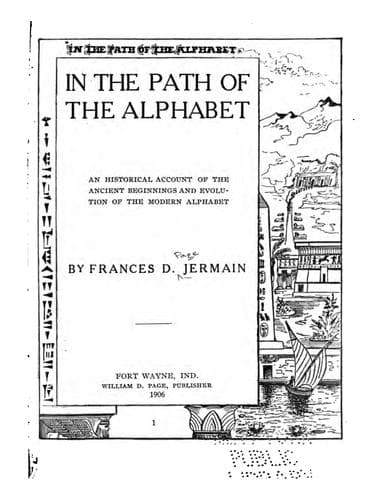
In the path of the alphabet: an historical account of the ancient beginnings and evolution of the modern alphabet — John Shaqi
In the path of the alphabet: an historical account of the ancient beginnings and evolution of the modern alphabetJermain, Frances Delavan Page
History
In the path of the alphabet: an historical account of the ancient beginnings and evolution of the modern alphabet
Jermain, Frances Delavan Page
Alphabet
The early opportunities which Champollion had enjoyed for the
preparation of his great work were peculiarly significant. He was
educated by his elder brother, a man of great learning, professor of
Greek in the Academy of Grenoble, whose companionship early influenced
the direction of his younger brother to linguistic studies. In addition
to this, the intense interest aroused throughout Europe by the vast
collection of antiquities brought thither by the men of letters and
science who accompanied Napoleon’s army in Egypt, had compelled the
attention of scholars to this special field of research as never before.
With this guidance, and moved by the spirit of the times, Champollion’s
studies in ancient Greek led him to an early acquaintance with the
Coptic language. It is said that, as a result of this study, at the age
of sixteen he read a paper before his academy, maintaining that the
Coptic was the language of the ancient Egyptians. This is not now a
spoken language, having been supplanted by the Arabic since the
seventeenth century, A. D. It, however, survives in the service ritual
of the Coptic churches of to-day, and, though written in old Greek
characters, the ancient language is still heard, though but few
understand it.
As Champollion made use of his hieroglyphic alphabet for the spelling of
other words than proper names, his satisfaction may be imagined when he
found that these were Coptic words. Thus, the sign for “mouth” for the
letter _R_, was the initial letter or syllabic sign of the Coptic word
_Ro_, signifying mouth. The picture of a lion for the letter _L_ also
represented the initial letter or initial syllable of _Lavo_, the Coptic
for lion. The picture of an eagle, representing the sign for the letter
_A_, is also the sign for the initial sound or letter in _Ahem_, the
Coptic for eagle, and so on.
The language, then, of the Hieroglyphs was Coptic, or rather in the
Coptic we have a survival of the ancient Egyptian, the language of the
pyramid builders. More correctly speaking, it is the Egyptian language
of the Ptolemaic period, corrupted with Arabic and Greek idioms, but
still including the language of old Egypt.
It was, indeed, a thing which might have been expected, that the
language expressed by the ancient Hieroglyphs should bear a resemblance
to Coptic, but that the resemblance should be as close as it has proved
could scarcely have been expected.
Again, of special interest in this connection, is the fact that in the
Greek the writing and language of Egypt should be thus preserved.
[1]“The romance of language could go no further,” says Mr. Butler, “than
to join the speech of Pharaoh and the writing of Homer in the service
book of an Egyptian Christian.”
At this point, a brief reference, bridging the centuries from the
decline of the use of hieroglyphics to the later appearance of the
language in its Coptic and Greek forms, should have a place.
Public-domain text, read in full here on John Shaqi.
Reviews
Reviews
No reviews yet
Be the first to share your thoughts on this work.
Join the Discussion
Join the discussion
Sign in to leave a comment or review.
Sign InorCreate an account