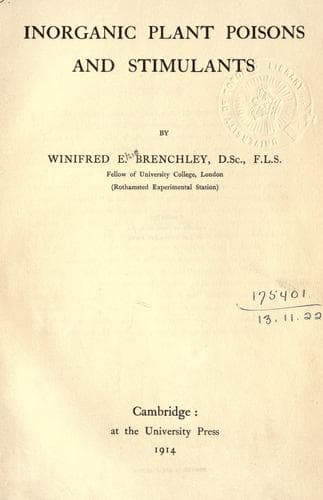
Inorganic Plant Poisons and StimulantsBrenchley, Winifred Elsie
Science
Inorganic Plant Poisons and Stimulants
Brenchley, Winifred Elsie
Growth (Plants); Plants -- Effect of poisons on
Storp (1883) experimented to determine the changes in the various
characters of the soil by the action of zinc salts on it, and he makes the
remarkable statement that in some soils the presence of zinc generates
free sulphuric acid, which is particularly injurious to plant life.
Grasses, young oaks and figs showed a decrease in dry weight, nitrogen
and fat, as the quantity of zinc compounds increased in the water added
to the soil. Both the quality and the quantity of the crop were adversely
affected. This decrease in the dry weight due to the presence of zinc was
confirmed by Jensch later on, and also by Nobbe, Baessler and Will (1884),
who state that both lead and zinc compounds work disadvantageously to
vegetation even when they are present in such small quantities that the
plants are outwardly sound, the harmful action appearing in the decrease
of dry weight. Contrary to Baumann’s opinion, zinc carbonate is said
to be one of the salts that exercises this insidious poisonous action.
Storp (1883) noticed that the direct poisonous action of zinc compounds
is largely destroyed by their admixture with soil, but he suggests that
a secondary cause of harm is introduced by the accumulation of insoluble
zinc salts, so that the fertility of the soil is impaired to the detriment
of the vegetation.
Ehrenberg (1908) throws out a suggestion that zinc is specially harmful
to plant life when it occurs in conjunction with ammonia, but no further
evidence has come to light.
(_d_) _Mode of action of zinc on plants._
The reason for the toxicity of zinc salts when present in soil forced
itself upon the attention of some of the early investigators in this
field. Freytag (1868) put forward the hypothesis that the zinc oxide is
partly or exclusively absorbed by the roots on account of the cell walls
of the root being corroded by the very thin layer of zinc salts lying in
contact with it--the same theory as has been held with regard to copper.
He stated also that the quantity of zinc oxide taken up by the plant
through its roots is strictly limited, not being proportional to the
quantity occurring in the soil, but varying between narrow limits. Krauch
(1882) found himself unable to accept another hypothesis which at one time
found favour, i.e. that the zinc salts kill the plants by coagulating the
protoplasm. If this were so, he argued, no plants at all could grow upon
soils containing zinc, and he was content to leave the cause as one yet to
be explained. Even at the present time, thirty years after, we know very
little more about the physiological cause of the toxicity of zinc.
2. _Effect of zinc compounds on germination._
Public-domain text, read in full here on John Shaqi.
Reviews
Reviews
No reviews yet
Be the first to share your thoughts on this work.
Join the Discussion
Join the discussion
Sign in to leave a comment or review.
Sign InorCreate an account