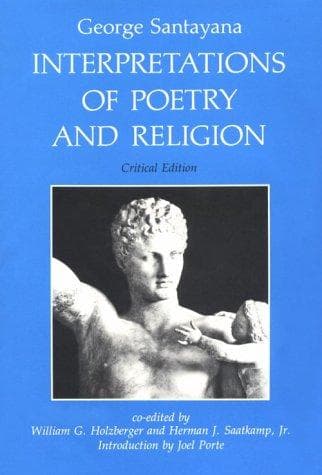
Interpretations of Poetry and ReligionSantayana, George
Religion
Interpretations of Poetry and Religion
Santayana, George
Aesthetics; Literature -- History and criticism; Poetry; Religion
Five senses, then, to gather a small part of the infinite influences
that vibrate in Nature, a moderate power of understanding to interpret
those senses, and an irregular, passionate fancy to overlay that
interpretation--such is the endowment of the human mind. And what is
its ambition? Nothing less than to construct a picture of all reality,
to comprehend its own origin and that of the universe, to discover
the laws of both and prophesy their destiny. Is not the disproportion
enormous? Are not confusions and profound contradictions to be looked
for in an attempt to build so much out of so little?
Yet the metaphysical ambition we speak of cannot be abandoned, because
whatever picture of things we may carry about in our heads we are bound
to regard as a map of reality; although we may mark certain tracts
of it "unexplored country," the very existence of such regions is
vouched for only by our representation, and is necessarily believed
to correspond to our idea. All we can do is, without abandoning
the aspiration to knowledge which is the inalienable birthright of
reason, to control as best we may the formation of our conceptions; to
arrange them according to their derivation and measure them by their
applicability in life, so prudently watching over their growth that we
may be spared the deepest of sorrows--to survive the offspring of our
own thought.
The inadequacy of each of our faculties is what occasions the intrusion
of some other faculty into its field. The defect of sense calls in
imagination, the defect of imagination calls in reasoning, the defect
of reasoning divination. If our senses were clairvoyant and able to
observe all that is going on in the world, if our instincts were
steady, prompting us to adequate reactions upon these observations, the
fancy might remain free. We should not need to call upon it to piece
out the imperfections of sense and reflection, but we should employ it
only in avowed poetry, only in building dream-worlds alongside of the
real, not interfering with the latter or confusing it, but repeating
its pattern with as many variations as the fertility of our minds
could supply. As it is, the imagination is brought into the service
of sense and instinct, and made to do the work of intelligence. This
substitution is the more readily effected, in that imagination and
intelligence do not differ in their origin, but only in their validity.
Understanding is an applicable fiction, a kind of wit with a practical
use. Common sense and science live in a world of expurgated mythology,
such as Plato wished his poets to compose, a world where the objects
are imaginative in their origin and essence, but useful, abstract, and
beneficent in their suggestions. The sphere of common sense and science
is concentric with the sphere of fancy; both move in virtue of the same
imaginative impulses. The eventual distinction between intelligence and
imagination is ideal; it arises when we discriminate various functions
Public-domain text, read in full here on John Shaqi.
Reviews
Reviews
No reviews yet
Be the first to share your thoughts on this work.
Join the Discussion
Join the discussion
Sign in to leave a comment or review.
Sign InorCreate an account