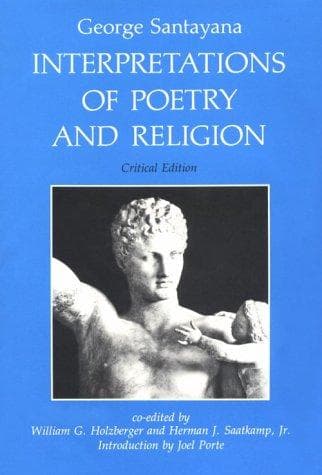
Interpretations of Poetry and ReligionSantayana, George
Religion
Interpretations of Poetry and Religion
Santayana, George
Aesthetics; Literature -- History and criticism; Poetry; Religion
in a life that is dynamically one. Those conceptions which, after
they have spontaneously arisen, prove serviceable in practice, and
capable of verification in sense, we call ideas of the understanding.
The others remain ideas of the imagination. The shortness of life,
the distractions of passion, and the misrepresentation to which all
transmitted knowledge is subject, have made the testing of ideas by
practice extremely slow in the history of mankind. Hence the impurity
of our knowledge, its confusion with fancy, and its painful inadequacy
to interpret the whole world of human interests. These shortcomings are
so many invitations to foreign powers to intervene, so many occasions
for new waves of imagination to sweep away the landmarks of our old
labour, and flood the whole mind with impetuous dreams.
It is accordingly the profounder minds that commonly yield to the
imagination, because it is these minds that are capable of feeling
the greatness of the problems of life and the inadequacy of the
understanding, with its present resources, to solve them. The same
minds are, moreover, often swayed by emotion, by the ever-present
desire to find a noble solution to all questions, perhaps a solution
already hallowed by authority and intertwined inextricably, for those
who have always accepted it, with the sanctions of spiritual life.
Such a coveted conclusion may easily be one which the understanding,
with its basis in sense and its demand for verification, may not be
able to reach. Therefore the impassioned soul must pass beyond the
understanding, or else go unsatisfied; and unless it be as disciplined
as it is impassioned it will not tolerate dissatisfaction. From what
quarter, then, will it draw the wider views, the deeper harmonies,
which it craves? Only from the imagination. There is no other faculty
left to invoke. The imagination, therefore, must furnish to religion
and to metaphysics those large ideas tinctured with passion, those
supersensible forms shrouded in awe, in which alone a mind of great
sweep and vitality can find its congenial objects. Thus the stone
which the builder, understanding, rejected, becomes the chief stone
of the corner; the intuitions which science could not use remain the
inspiration of poetry and religion.
Public-domain text, read in full here on John Shaqi.
Reviews
Reviews
No reviews yet
Be the first to share your thoughts on this work.
Join the Discussion
Join the discussion
Sign in to leave a comment or review.
Sign InorCreate an account