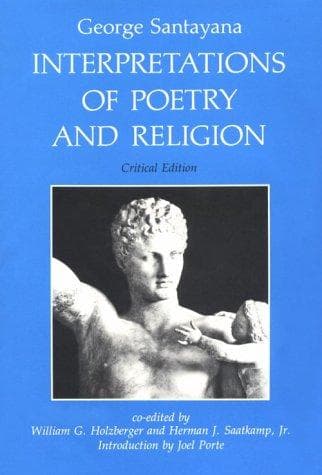
Interpretations of Poetry and Religion — John Shaqi
Interpretations of Poetry and ReligionSantayana, George
Religion
Interpretations of Poetry and Religion
Santayana, George
Aesthetics; Literature -- History and criticism; Poetry; Religion
The imagination, when thus employed to anticipate or correct the
conclusions of the understanding, is of course not called imagination
by those, who appeal to it. The religious teachers call it prophecy or
revelation, the philosophers call it a higher reason. But these names
are merely eulogistic synonyms for imagination, implying (what is
perfectly possible) that the imagination has not misled us. They imply
on the contrary that in the given instances the imagination has hit
upon an ultimate truth. A prophet, unless he be the merely mechanical
vehicle of truths he does not understand, cannot be conceived as
anything but a man of imagination, whose visions miraculously mirror
the truth. A metaphysician who transcends the intellect by his reason
can be conceived only as using his imagination to such good purpose
as to divine by it the ideal laws of reality or the ultimate goals of
moral effort. His reason is an imagination that succeeds, an intuition
that guesses the principle of experience. But if this intuition were of
such a nature that experience could verify it, then that higher reason
or imagination would be brought down to the level of the understanding;
for understanding, as we have defined it, is itself a kind of
imagination, an imagination prophetic of experience, a spontaneity of
thought by which the science of perception is turned into the art of
life. The same absence of verification distinguishes revelation from
science; for when the prophecies of faith are verified, the function
of faith is gone. Faith and the higher reason of the metaphysicians
are therefore forms of imagination believed to be avenues to truth,
as dreams or oracles may sometimes be truthful, not because their
necessary correspondence to truth can be demonstrated, for then they
would be portions of science, but because a man dwelling on those
intuitions is conscious of a certain moral transformation, of a certain
warmth and energy of life. This emotion, heightening his ideas and
giving them power over his will, he calls faith or high philosophy, and
under its dominion he is able to face his destiny with enthusiasm, or
at least with composure.
Public-domain text, read in full here on John Shaqi.
Reviews
Reviews
No reviews yet
Be the first to share your thoughts on this work.
Join the Discussion
Join the discussion
Sign in to leave a comment or review.
Sign InorCreate an account