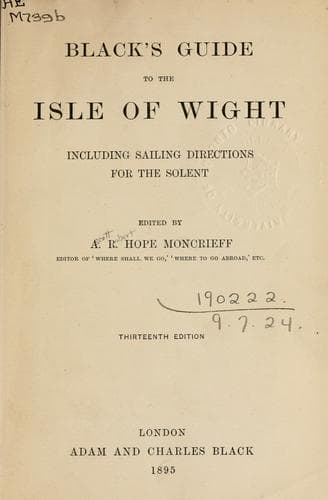
Isle of WightMoncrieff, A. R. Hope (Ascott Robert Hope)
History
Isle of Wight
Moncrieff, A. R. Hope (Ascott Robert Hope)
Isle of Wight (England) -- Description and travel
Across these zones of length, the Island is cut into two almost equal
parts by its chief river, the Medina, cleaving the central Downs near
Newport; and through gaps at either end flow two smaller rivers bearing
the same name of Yar, which seems to call Celtic cousinship with the
Garonne of France. For the Medina, as for the Medway, some such
derivation as the _Mid_ stream has been naturally suggested; but with
the fear of Dr Bradley upon me, I would pass lightly over the quaking
bog of place nomenclature. These three rivers have the peculiarity of
flowing almost right across the Island, a course so short that they may
well take their time about it. The other streams are of little
importance, except in the way of scenery. On the north side they form
shallow branching creeks which get from as much as they give to the sea,
that at high tide bears brown sails far inland among trees and hedges.
On the south, wearing their way down through the elevated shore line,
they carve out those abrupt chasms known as Chines, celebrated among the
beauty spots of this coast. The richest valley seems to be that of the
larger Yar, which turns into the sea at the north-east corner. The parts
most rich in natural charms are the south-eastern corner, with its
overgrown landslips, and the fissured chalk cliffs of the western
promontory beyond Freshwater.
All that variety of soil and surface is packed together into a roughly
rhomboidal shape, 23 miles long by 13 or 14 miles at the broadest, about
the size of Greater London, or say 1/36000 part of the habitable globe.
Within its circumference of 60 miles or so, this space of some 96,000
square acres holds a population of 82,000, beside innumerable transient
visitors. A pundit of figures has taken the trouble to calculate that
all the population of the world could find standing room in the Island
on the foot of four to the square yard, if the human race agreed on
spending a Bank Holiday here; but then little room might be left for
donkey-rides or switch-back railways. While we are on the head of
statistics, it may be mentioned that several scores of guide-books to
the Isle of Wight have been published, from Sir Henry Englefield’s noble
folio to the small brochures issued by hotels, these works containing on
an average 206,732 words, mostly superfluous in many cases; that 810,427
picture post-cards or thereabouts pass annually through the post-offices
of the island; that, in ordinary seasons, it sits to 1723 cameras; that
the hotel-bills annually paid in it would, if tacked together, reach
from St Petersburg to Yokohama, or if pasted over one another, make a
pile as high as the new War Office; and that 11.059 per cent. of the
newly married couples of Brixton, Balham, Upper Tooting, etc., are in
each year estimated to spend at least part of their honeymoon here, who
come back to confirm a prevailing belief that in no other part of the
British Isles does the moon shine so sweetly; while, indeed, a not quite
Public-domain text, read in full here on John Shaqi.
Reviews
Reviews
No reviews yet
Be the first to share your thoughts on this work.
Join the Discussion
Join the discussion
Sign in to leave a comment or review.
Sign InorCreate an account