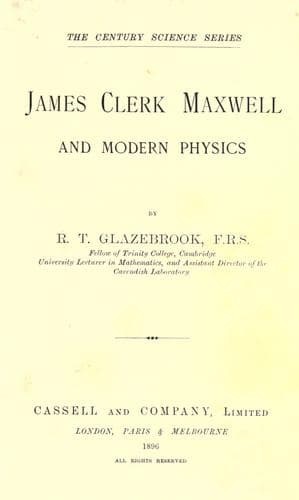
James Clerk Maxwell and Modern PhysicsGlazebrook, Richard
History
James Clerk Maxwell and Modern Physics
Glazebrook, Richard
Maxwell, James Clerk, 1831-1879; Physics -- History
it would be given to enlarge the bounds of human knowledge.
It was a position which might have turned the head of a
smaller man; but the friend of whom we were all so proud, and
who seemed, as it were, to link us thus early with the great
outside world of the pioneers of knowledge, had one of those
rich and lavish natures which no prosperity can impoverish,
and which make faith in goodness easy for others. I have often
thought that those who never knew the grand old Adam Sedgwick
and the then young and ever-youthful Clerk Maxwell had yet to
learn the largeness and fulness of the moulds in which some
choice natures are framed. Of the scientific greatness of our
friend we were most of us unable to judge; but anyone could
see and admire the boy-like glee, the joyous invention, the
wide reading, the eager thirst for truth, the subtle thought,
the perfect temper, the unfailing reverence, the singular
absence of any taint of the breath of worldliness in any of its
thousand forms.
“Brethren, you may know such men now among your college
friends, though there can be but few in any year, or indeed in
any century, that possess the rare genius of the man whom we
deplore. If it be so, then, if you will accept the counsel of
a stranger, thank God for His gift. Believe me when I tell you
that few such blessings will come to you in later life. There
are blessings that come once in a lifetime. One of these is the
reverence with which we look up to greatness and goodness in
a college friend--above us, beyond us, far out of our mental
or moral grasp, but still one of us, near to us, our own. You
know, in part at least, how in this case the promise of youth
was more than fulfilled, and how the man who, but a fortnight
ago, was the ornament of the University, and--shall I be
wrong in saying it?--almost the discoverer of a new world of
knowledge, was even more loved than he was admired, retaining
after twenty years of fame that mirth, that simplicity, that
child-like delight in all that is fresh and wonderful which we
rejoice to think of as some of the surest accompaniment of true
scientific genius.
Public-domain text, read in full here on John Shaqi.
Reviews
Reviews
No reviews yet
Be the first to share your thoughts on this work.
Join the Discussion
Join the discussion
Sign in to leave a comment or review.
Sign InorCreate an account