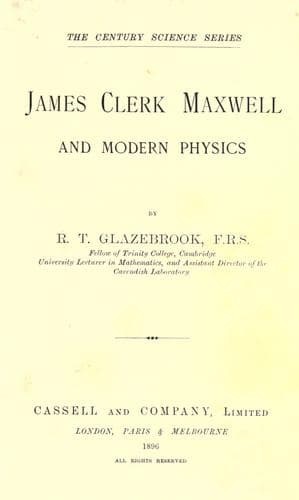
James Clerk Maxwell and Modern PhysicsGlazebrook, Richard
History
James Clerk Maxwell and Modern Physics
Glazebrook, Richard
Maxwell, James Clerk, 1831-1879; Physics -- History
External authority was necessary before the colleges would submit
to taxation for University purposes, and it was left to the Royal
Commission of 1877 to carry into effect many of the suggestions
made by the Syndicate. Meanwhile they contented themselves with
recommending means for raising an annual stipend of £660 for the
professor, demonstrator, and assistant, and a capital sum of £5,000, or
thereabouts, for the expenses of a building.
The Syndicate’s Report was issued in an amended form in the May term of
1870, and before any decision was taken on it the Vice-Chancellor, Dr.
Atkinson, on October 13th, 1870, published “the following munificent
offer of his grace the Duke of Devonshire, the Chancellor of the
University,” who had been chairman of the Commission on Scientific
Education.
“Holker Hall, Grange, Lancashire.
“MY DEAR MR. VICE-CHANCELLOR,--I have the honour to address you
for the purpose of making an offer to the University, which, if
you see no objection, I shall be much obliged to you to submit
in such manner as you may think fit for the consideration of
the Council and the University.
“I find in the report dated February 29th, 1869, of the
Physical Science Syndicate, recommending the establishment of
a Professor and Demonstrator of Experimental Physics, that the
buildings and apparatus required for this department of science
are estimated to cost £6,300.
“I am desirous to assist the University in carrying this
recommendation into effect, and shall accordingly be prepared
to provide the funds required for the building and apparatus as
soon as the University shall have in other respects completed
its arrangements for teaching Experimental Physics, and shall
have approved the plan of the building.
“I remain, my dear Mr. Vice-Chancellor,
“Yours very faithfully,
“DEVONSHIRE.”
By his generous action the University was relieved from all expense
connected with the building. A Grace establishing a Professorship of
Experimental Physics was confirmed by the Senate February 9th, 1871,
and March 8th was fixed for the election.
Meanwhile who was to be Professor? Sir W. Thomson’s name had been
mentioned, but he, it was known, would not accept the post. Maxwell
was then applied to, and at first he was unwilling to leave Glenlair.
Professor Stokes, the Hon. J. W. Strutt (Lord Rayleigh), Mr. Blore
of Trinity, and others wrote to him. Lord Rayleigh’s letter[35] is as
follows:
“Cambridge, 14th February, 1871.
Public-domain text, read in full here on John Shaqi.
Reviews
Reviews
No reviews yet
Be the first to share your thoughts on this work.
Join the Discussion
Join the discussion
Sign in to leave a comment or review.
Sign InorCreate an account