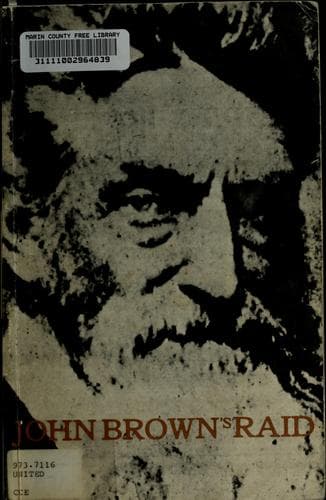
John Brown's RaidUnited States. National Park Service
History
John Brown's Raid
United States. National Park Service
Brown, John, 1800-1859; Harpers Ferry (W. Va.) -- History -- John Brown's Raid, 1859
The first muskets, based on the old French infantry type of 1763, were
completed in 1801. In 1803 production was expanded to include rifles,
and 2 years later the manufacture of pistols. (The Model 1805 pistol,
made at Harpers Ferry, was the first hand weapon to be produced at a
United States armory.) At first the rate of musket production was
meager, but by 1810 the armory was turning out 10,000 annually, storing
them in two arsenal buildings nearby on Shenandoah Street.
In 1819 John Hall, a Maine gunsmith, received a contract from the
Federal Government to manufacture 1,000 breech-loading flintlock rifles
of his own design. Sent to Harpers Ferry, he set up the Hall Rifle Works
in two buildings on Lower Hall Island, which adjoined Virginius Island
in the Shenandoah River about ½ mile from its junction with the Potomac.
Hall’s rifles were made on so exact a scale that all the parts were
interchangeable—a factor that helped to pave the way for modern mass
production methods. The War Department was elated with Hall’s success
and his contract was repeatedly renewed. When the Hall rifle was
discontinued in 1844, the Government tore down the old buildings and
erected a new rifle factory on the same site. Standard U.S. Model rifles
were produced there until the industry was destroyed, along with the
armory complex, at the outbreak of the Civil War in 1861.
The abundance of water power that had attracted the arms industry soon
brought others. Besides the rifle factories on Hall Island, Virginius
Island boasted an iron foundry, flour mill, cotton mill, and machine
shop, all powered by water diverted through the island by a dam in the
Shenandoah River and a series of sluiceways and underground water
tunnels. More than 200 persons made their home around the prospering
island industries.
The formation, development, and expansion of the United States Armory
and Arsenal at Harpers Ferry (its complete, official designation) was
the chief stimulus for the growth of the town. From a simple beginning
the armory by 1859 had spread to include 20 workshops and offices, lined
in a neat double row over an area 600 yards long. At its peak, the
armory provided employment for more than 400 men, mostly transplanted
Northerners whom local residents classified as “foreigners.” In the
65-year history of this major industry, the U.S. Government invested
nearly $2 million in land, water power improvements, walls and
embankments, hydraulic machinery, and buildings.
[Illustration: HARPERS FERRY AND VICINITY 1859]
Public-domain text, read in full here on John Shaqi.
Reviews
Reviews
No reviews yet
Be the first to share your thoughts on this work.
Join the Discussion
Join the discussion
Sign in to leave a comment or review.
Sign InorCreate an account