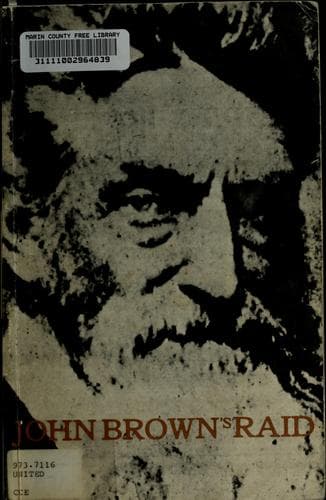
John Brown's RaidUnited States. National Park Service
History
John Brown's Raid
United States. National Park Service
Brown, John, 1800-1859; Harpers Ferry (W. Va.) -- History -- John Brown's Raid, 1859
After 1830 Harpers Ferry, already recognized as an important industrial
center, attained prominence as a vital link in the transportation and
communications line between the Ohio and Shenandoah Valleys and the
East. By 1830 a semi-weekly stagecoach service connected the town with
Washington, D.C. The one-way trip usually required a full day’s travel.
That same year a turnpike company was founded to construct a 16-mile
macadamized toll road from Harpers Ferry to Middleway, 5 miles west of
Charles Town. A turnpike being built from Frederick, Md., about 20 miles
to the east, reached the town in 1832. Still another turnpike company,
organized in 1851, ran a road from Harpers Ferry southeastward to
Hillsborough, about 10 miles away.
But the signal impetus to the establishment of the town’s commercial
position was the arrival of canal and railroad. Waging a bitter battle
to reach the rich Ohio Valley and carry its trade to the East, impeding
each other’s progress at every opportunity, the Chesapeake and Ohio
Canal (originating in Washington, D.C.) and the Baltimore and Ohio
Railroad (originating in Baltimore, Md.) reached Harpers Ferry in the
early 1830’s. Following the winding Potomac River northward and westward
from Georgetown, the C & O Canal arrived at Harpers Ferry in November
1833, more than a year ahead of its rival. But the railroad pushed on to
the Ohio Valley while the canal stopped at Cumberland, Md. The
establishment of these two arteries provided shippers with a cheaper
carrier for their products and assured travelers of a more efficient and
economical means of reaching their destinations.
With the expansion of industry and the development of superior
transportation facilities, the population of the community swelled to
nearly 3,000 by 1859. Of these about 150 were “free coloreds” and 150
were slaves. The total number of slaves in the entire six-county area
around Harpers Ferry was just slightly more than 18,000, of which less
than 5,000 were men. There were no large plantations because the land
and the climate could not sustain a plantation economy. The few
slaveholders maintained farms, and their blacks were mainly “well-kept
house-servants.”
Most of the white residents of Harpers Ferry worked at the armory or at
the manufacturing plants on Virginius Island. Because land was at a
premium, the houses, saloons, hotels, and shops were tightly aligned
along Shenandoah, Potomac, and High Streets, and sprawled up the slopes
of Bolivar Heights. In some places the rocky cliffs were blasted away to
make room for another building. Most of the homes were of simple design,
but the Government-built residences of the armory officials were more
elaborate.
Public-domain text, read in full here on John Shaqi.
Reviews
Reviews
No reviews yet
Be the first to share your thoughts on this work.
Join the Discussion
Join the discussion
Sign in to leave a comment or review.
Sign InorCreate an account