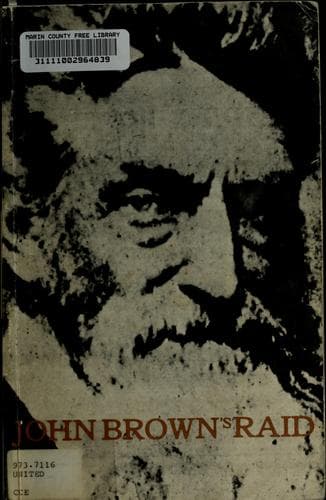
John Brown's RaidUnited States. National Park Service
History
John Brown's Raid
United States. National Park Service
Brown, John, 1800-1859; Harpers Ferry (W. Va.) -- History -- John Brown's Raid, 1859
The inhabitants of the town were chiefly of Irish, English, and German
descent. Besides building six churches of varying faiths (one of which,
St. Peter’s Catholic Church, is still standing and in use today), they
established five private girls’ schools. A man could get a drink at the
Gault House or take a meal at the Potomac Restaurant or the Wager House.
If he so desired, he could join the Masons, the Odd Fellows, or the Sons
of Temperance. Nearly everyone was prosperous. It was a good time for
the town and its people.
[Illustration: This photograph of Harpers Ferry from the Maryland
side of the Potomac shows the town as it appeared about the time of
the raid. The Baltimore and Ohio Railroad bridge, by which John
Brown and his raiders entered the village, is at the left.]
John Brown arrived amidst this prosperity on July 3, 1859. Not yet 60
years old, the rigors of frontier living had nevertheless left their
imprint upon him and there were those who said he looked and walked more
than ever “like an old man.” In March a Cleveland, Ohio, newspaper had
described him as “a medium-sized, compactly-built and wiry man, and as
quick as a cat in his movements. His hair is of a salt and pepper hue
and as stiff as bristles, he has a long, waving, milk-white goatee,
which gives him a somewhat patriarchal appearance, his eyes are gray and
sharp.” He had grown the beard before his last trip to Kansas in 1858,
and it covered his square chin and straight, firm mouth, changing his
appearance markedly. When he arrived in Harpers Ferry the beard had been
shortened to within an inch and a half of his face, because, his
daughter Annie later recalled, he thought it “more likely to disguise
him than a clean face or than the long beard.”
With Brown were two of his sons—34-year-old Owen and 20-year-old
Oliver—and Kansas veteran Jeremiah G. Anderson. The 26-year-old,
Indiana-born Anderson was the grandson of Southern slaveholders and had
joined the abolitionist cause in 1857 after working several unproductive
years as a peddler, farmer, and sawyer. Determined to eliminate slavery,
Anderson once vowed to “make this land of liberty and equality shake to
the centre.”
After consulting briefly with Cook, who had been serving as a
schoolteacher, book salesman, and canal-lock tender, and had even
married a local girl since being sent to Harpers Ferry the year before,
Brown and his three companions took up residence in a private home in
Sandy Hook, a small village about a mile down the Potomac on the
Maryland shore. The names they gave their landlord were “Isaac Smith &
Sons.” To anyone asking their business in the area, Brown told them they
were simple farmers looking for good farmland to develop.
Public-domain text, read in full here on John Shaqi.
Reviews
Reviews
No reviews yet
Be the first to share your thoughts on this work.
Join the Discussion
Join the discussion
Sign in to leave a comment or review.
Sign InorCreate an account