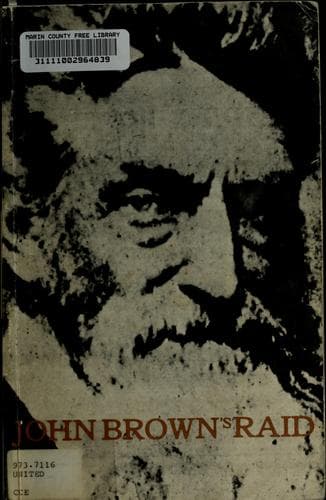
John Brown's RaidUnited States. National Park Service
History
John Brown's Raid
United States. National Park Service
Brown, John, 1800-1859; Harpers Ferry (W. Va.) -- History -- John Brown's Raid, 1859
Brown arose early on July 4 and began exploring the Maryland side of the
Potomac to find a suitable hideout for his raiders. Local inquiry led
him to a farm owned by the heirs of a Dr. R. F. Kennedy about 5 miles
north of Harpers Ferry. A cursory inspection convinced him that the
place, though small, was conveniently located and admirably suited for
concealment. The farm was remote from other settlements, and it was
surrounded by woods and hidden by undergrowth—an ideal situation for
hiding men and supplies from the gaze of inquisitive neighbors.
[Illustration: John Brown in May 1859.]
For $35 in gold Brown rented the farm, which consisted of two log
structures, some outbuildings, and a pasture. The main house sat about
100 yards off the public road connecting Harpers Ferry with
Boonesborough and Sharpsburg, Md., and contained a basement kitchen and
storerooms, a second-floor living room and bedrooms, and an attic. The
second floor was used as kitchen, parlor, and dining room, and the attic
served as a storeroom, drilling room, and “prison” to keep the men out
of sight. Near the farmhouse stood a small cabin that later became a
storage place and sleeping quarters for some of the raiders.
[Illustration: The isolated character of the Kennedy farm did not
prevent curious neighbors from “dropping in” for a visit.]
[Illustration: To help avert suspicion, Brown’s daughter Annie and
Oliver’s wife Martha (shown here with her husband in 1859) lived at
the farm while the arms and men were being assembled. Martha did the
cooking and helped Annie with household chores.]
Brown’s chief fear was that neighbors would become suspicious of “Isaac
Smith & Sons” and possibly uncover his revolutionary plans. Reasoning
that nearby families would be less distrustful with women among the
group, he appealed to his wife and daughter Annie at their home in North
Elba, N.Y., to come live with him, saying that “It will be likely to
prove the most valuable service you can ever render to the world.” Mrs.
Brown was unable to make the long journey, but Annie and Oliver’s wife
Martha did join him in mid-July. Their presence proved of inestimable
value not only in alleviating suspicion but in contributing to the
morale of the men. Martha served as cook and housekeeper, preparing
meals on a wood stove in the upstairs living room; Annie kept constant
watch for prying neighbors. “When I washed dishes,” noted Annie many
years later,
I stood at the end of the table where I could see out of the window
and open door if any one approached the house. I was constantly on the
lookout while carrying the victuals across the porch, and while I was
tidying or sweeping the rooms, and always at my post on the porch when
the men were eating. My evenings were spent on the porch or sitting on
the stairs, watching or listening.
[Illustration: The Kennedy farmhouse served as the base of
operations for John Brown’s raiders.]
Public-domain text, read in full here on John Shaqi.
Reviews
Reviews
No reviews yet
Be the first to share your thoughts on this work.
Join the Discussion
Join the discussion
Sign in to leave a comment or review.
Sign InorCreate an account