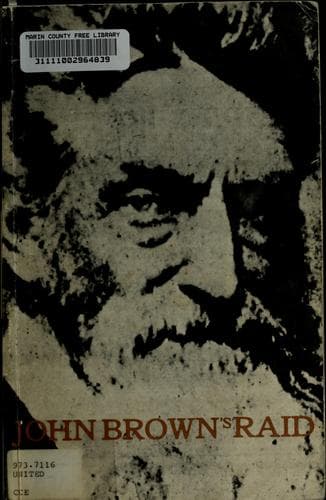
John Brown's RaidUnited States. National Park Service
History
John Brown's Raid
United States. National Park Service
Brown, John, 1800-1859; Harpers Ferry (W. Va.) -- History -- John Brown's Raid, 1859
As early as February 1862 a young Union staff officer assigned to the
Harpers Ferry area could write of the town: “The appearance of ruin by
war and fire was awful. Charred ruins were all that remain of the
splendid public works, arsenals, workshops and railroads, stores,
hotels, and dwelling houses all mingled in one common destruction.” Much
the same observation was made 3 years later in the summer of 1865 by
John T. Trowbridge, a New England writer, during a tour of the South:
“[T]he town is the reverse of agreeable. It is said to have been a
pleasant and picturesque place formerly. The streets were well graded,
and the hill-sides above were graced with terraces and trees. But war
has changed all. Freshets tear down the centre of the streets, and the
hill-sides present only ragged growths of weeds. The town itself lies
half in ruins.... Of the bridge across the Shenandoah only the ruined
piers are left; still less remains of the old bridge over the Potomac.
And all about the town are rubbish, filth and stench.”
The once-imposing armory complex along the Potomac River and the rifle
works on Hall Island in the Shenandoah were burned-out hulks. Only the
armory enginehouse remained basically intact, “like a monument which no
Rebel hands were permitted to demolish.” Large sections of the town had
been burned by various troop contingents to prevent their use by enemy
soldiers. Many homes, churches, schools, and business establishments
were damaged beyond repair by shot and shell fired from the surrounding
heights. Still other buildings, subjected to long military use, were on
the verge of ruin. The industries on Virginius Island—the iron foundry,
the flour mill, the sawmill, the machine shops, the cotton mill—were
also gone, and Harpers Ferry no longer had the activity and bustle of an
economically healthy community.
Besides the material damage inflicted by powerful weaponry and by the
seemingly endless procession of soldiers who filched or requisitioned
everything that could be carried away, the town suffered an even greater
loss—its people. During the war most of the townspeople moved away, some
to escape the dangers of military operations, some to seek employment
elsewhere after the armory and the industries were destroyed, and some
to join one or the other opposing armies. Many never came back. Those
who did return found their town in ruins and themselves the citizens of
a new State.
Public-domain text, read in full here on John Shaqi.
Reviews
Reviews
No reviews yet
Be the first to share your thoughts on this work.
Join the Discussion
Join the discussion
Sign in to leave a comment or review.
Sign InorCreate an account