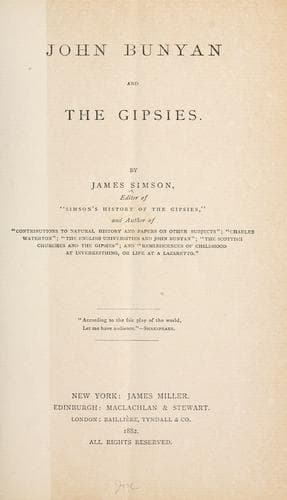
Bunyan, John, 1628-1688 -- Relations with Romanies; Leland, Charles Godfrey, 1824-1903; Romanies
In discussing the question of the origin of the Gipsies with some English
members of the race, I found that “a very intelligent Gipsy informed me
that his race sprang from a body of men—a cross between the Arabs and
Egyptians—that left Egypt in the train of the Jews” (p. 14). And I wrote
when I published this, that “the intelligent reader will not differ with
me as to the weight to be attached to the Gipsy’s remark on this point.”
To that question I devoted ten (13–23) closely printed pages to
demonstrate that the “mixed multitude,” or part of it, that left Egypt
with Moses, after separating from the Jews, travelled East into Northern
Hindostan, where they formed the Gipsy caste (p. 21); becoming in every
way a people like the Gipsy so far as he is known to the public to-day.
I further said that this people “travelled East, _their own masters_, and
became the origin of the Gipsy nation throughout the world” (p. 40).
“What objection could any one advance against the Gipsies being the
people that left Egypt in the train of the Jews? Not certainly an
objection as to race, for there must have been many captive people or
tribes introduced into Egypt from the many countries surrounding it .
. . That the ‘mixed multitude’ travelled into India, acquired the
language of that part of Asia, _and perhaps modified its appearance
there_, and became the origin of the Gipsy race, we may safely assume
. . . Everything harmonizes so beautifully with the idea that the
Gipsies are the ‘mixed multitude’ of the Exodus that it may be
admitted by the world. Even in the matter of religion, we could
imagine Egyptian captives losing a knowledge of their religion, as
has happened with the Africans in the New World, {14} and, not having
had another taught them, leaving Egypt under Moses without any
religion at all. After entering India they would in all probability
become a wandering people, and for a certainty live aloof from all
others” (pp. 494–496). “If we could but find traces of an Egyptian
origin among the Gipsies of Asia, say Central and Western Asia, the
question would be beyond dispute. But that might be a matter of some
trouble” (p. 40).
In this way Mr. Leland’s informant, John Nano, if he was correct in what
he said, confirmed my conjecture as to the Gipsies’ Egyptian or rather
Syrian origin; for after escaping from Egypt they would remain for some
time in Syria or its neighbourhood before they would become a body and
proceed East. As illustrative of Mr. Leland’s desire to “give quite as
good an opportunity to others who are in our business as to ourselves,” I
find him writing thus:—
Public-domain text, read in full here on John Shaqi.
Reviews
Reviews
No reviews yet
Be the first to share your thoughts on this work.
Join the Discussion
Join the discussion
Sign in to leave a comment or review.
Sign InorCreate an account