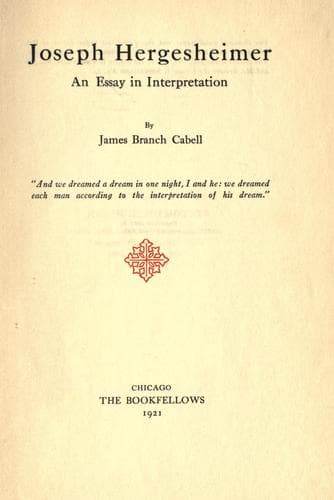
Joseph Hergesheimer, an essay in interpretationCabell, James Branch
General
Joseph Hergesheimer, an essay in interpretation
Cabell, James Branch
Hergesheimer, Joseph, 1880-1954 -- Criticism and interpretation
Well, and to Linda, also, was beauty a nuisance—“a bitter and luxurious
god,” that implacably required to be honored with sacrifices of common
joys and ties and ruddy interests, but was none the less divine.
Sustained by this sole knowledge, Linda Hallet passes out of the story,
when youth is over, regarding not very seriously that which is human
and ephemeral, even as embodied in her lovers and her children, nor in
herself, but rather always turning grave blue eyes toward that which
is divine; passes, at once the abandoned sanctuary, the priestess,
the postulant, and the martyr, of that beauty to which fools had once
referred as “hers”; passes not as the wreckage of a toy but as an
outworn instrument which has helped to further the proud labor of a
god; and passes, as all must pass, without any sure comprehension of
achievement, but with content. That, really, is _The Happy End_....
SIX
Which reminds me that for the most part I am rattling very old bones.
Those seemingly unfruitful fourteen years are to-day at one with those
other fourteen years which brought an elder Joseph into Egyptian
publicity. Mr. Hergesheimer has “arrived”: his books have found their
proper and appreciative audience; whereas his short stories are
purchased, and probably read, along with the encomiums of ready-made
clothing and safety razors, by the I forget how many million buyers of
the world’s most popular magazine....
Now, here, I think, one finds stark provocations of uneasiness. I
speak with diffidence, and am not entirely swayed, I believe, by the
natural inclination of every writer to backbite his fellow craftsman.
In any event, dismissing _Gold and Iron_ (after some reflection) with
unqualified applause, I take up _The Happy End_; and of the seven
stories contained therein six seem to me to display a cornerstone of
eminently “popular” psychology, ranging from the as yet sacrosanct
belief that all Germans are perfectly horrid people, to the axiom
that the quiet and unrespected youngest brother is invariably the one
to exterminate the family enemies, and duly including the sentiment
that noble hearts very often beat under ragged shirts. And I am made
uneasy to see these uplifting faiths—these literary baking-powders more
properly adapted to the Horrible Trites and the Gluepot Stews among
reading-matter confectioners—thus utilized by a Joseph Hergesheimer.
Public-domain text, read in full here on John Shaqi.
Reviews
Reviews
No reviews yet
Be the first to share your thoughts on this work.
Join the Discussion
Join the discussion
Sign in to leave a comment or review.
Sign InorCreate an account