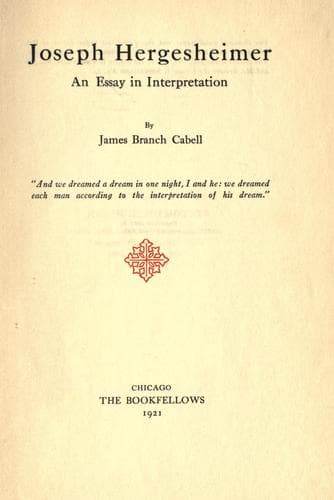
Joseph Hergesheimer, an essay in interpretationCabell, James Branch
General
Joseph Hergesheimer, an essay in interpretation
Cabell, James Branch
Hergesheimer, Joseph, 1880-1954 -- Criticism and interpretation
I am made uneasy because I reason in this way: when Mr. Hergesheimer
consciously is writing a short story to be printed next to advertising
matter in some justly popular periodical, Mr. Hergesheimer, being
rational and human, cannot but think of the subscribers to that
popular periodical. I forget, I repeat, how many millions of them have
been duly attested upon affidavit to exist, but certainly not many
thousands of our fellow citizens can regard Mr. Hergesheimer at his
best and purest with anything save bewildered abhorrence. So he must
compromise,—subconsciously, I believe,—and must adapt his methods
to the idiosyncrasies and limitations of his audience, very much as
he probably refrains from addressing his cook in the heightened and
consummated English of _San Cristóbal de la Habana_.
The danger is not that Joseph Hergesheimer will lower his ideals, nor
in anything alter what he wishes to communicate; but is the fact that
he must attempt to transmit these things into the vernacular and into
the orbits of thought of his enormous audience, with the immaculate
motive of making his ideas comprehensible. He cannot, being rational
and human, but by and by be tempted yet further to endeavor—as he has
flagrantly endeavored in the tale called _Tol’able David_—to convey his
wayside apprehensions of life via some such always acceptable vehicle
as the prehistoric fairy-tale cliché of the scorned and ultimately
victorious third champion. This is with a vengeance the pouring of
new wine into a usage-battered and always brazen cup which spoils the
brew....
Six of these stories, then, are beautifully written moral tales:
although, to be sure, there is an alleviating seventh, in _The Flower
of Spain_, which is a well-nigh perfect and a profoundly immoral work
of art. I therefore put aside this volume with discomfort....
But I suspect that here the axiomatic mutual jealousy of all authors
should be discounted. As an “outsider” in letters, I cannot be
expected quite to view with equanimity the recent installation of Mr.
Hergesheimer in the National Institute of Arts and Letters, that august
body wherein the other representatives of creative literature are
such approved masters as Mr. Nelson Lloyd and Mr. Robert W. Chambers
and Mr. L. Frank Tooker. At this port, with appropriate ceremony, has
the skipper of _The Happy End_ “arrived.” The fact has been formally
recognized, by our most “solid” cultural element, that in artistic
achievement Joseph Hergesheimer has but fifty living superiors, and
only a hundred and ninety-nine equals at this moment resident in the
United States: and I, who have not been tendered any such accolade,
cannot but be aware of human twinges when Mr. Hergesheimer as a matter
of course accepts this distinction.
Public-domain text, read in full here on John Shaqi.
Reviews
Reviews
No reviews yet
Be the first to share your thoughts on this work.
Join the Discussion
Join the discussion
Sign in to leave a comment or review.
Sign InorCreate an account