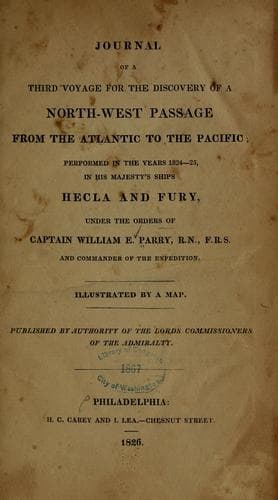
Journal of the Third Voyage for the Discovery of a North-West Passage — John Shaqi
Journal of the Third Voyage for the Discovery of a North-West PassageParry, William Edward, Sir
History
Journal of the Third Voyage for the Discovery of a North-West Passage
Parry, William Edward, Sir
Arctic regions -- Discovery and exploration -- British; Fury (Ship); Hecla (Ship); Northwest Passage
I was now in hopes we should have made some progress, for a large channel
of clear water was left open in-shore; a breeze blew off the land, and
the temperature of the atmosphere had again risen considerably. We had
not sailed five miles, however, when a westerly wind took us aback, and a
most dangerous swell set directly upon the shore, obliging me immediately
to stand off the land; and the _Fury_ being still to the eastward of the
point, I ran round it, in order to rejoin her before sunset. The current
was here setting very fast to the eastward, not less, I think, in some
places, than two miles an hour, so that, even in a clear sea, we had
little chance of stemming it, much less beset as we were in young ice
during an unusually dark night of nine or ten hours’ duration, with a
heavy fall of snow. The consequence was, that when we made the land on
the morning of the 23rd, we had been drifted the incredible distance of
eight or nine leagues during the night, finding ourselves off the
Wollaston Islands at the entrance of Navy Board Inlet. We stood in under
the islands to look for anchorage during the night, but the water being
everywhere too deep close to the shore, we made fast at sunset to some
very heavy ice upon a point, which we took to be the main land, but which
Captain Hoppner afterwards found to be upon one of the islands, which are
at least four in number.
After midnight on the 27th the wind began to moderate, and by degrees
also drew more to the southward than before. At daylight, therefore, we
found ourselves seven or eight miles from the land; but no ice was in
sight, except the “sludge,” of honey-like consistence, with which almost
the whole sea was covered. A strong blink, extending along the eastern
horizon, pointed out the position of the main body of ice, which was
farther distant from the eastern shore of the inlet than I ever saw it.
Being assisted by a fine working breeze, which at the same time prevented
the formation of any more ice to obstruct us, we made considerable
progress along the land, and at noon were nearly abreast of Jackson
Inlet, which we now saw to be considerably larger than our distant view
of it on the former voyage had led us to suppose. We found also that
what at a distance appeared an island in the entrance was in reality a
dark-looking rocky hill, on the south side. A few more tacks brought us
to the entrance of Port Bowen, which for two or three days past I had
determined to make our wintering-place, if, as there was but little
reason to expect, we should be so fortunate as to push the ships thus
far. My reasons for coming to this determination, in which Captain
Hoppner’s opinion also served to confirm me, will be sufficiently
gathered from the operations of the preceding fortnight, which convinced
me that the precarious chance of making a few miles’ more progress could
no longer be suffered to weigh against the evident risk now attending
Public-domain text, read in full here on John Shaqi.
Reviews
Reviews
No reviews yet
Be the first to share your thoughts on this work.
Join the Discussion
Join the discussion
Sign in to leave a comment or review.
Sign InorCreate an account